

What's the point of Ahrefs or Semrush if the data is this wrong?
I asked that on X this week, with two screenshots of the same client site.
Ahrefs showed organic traffic more than doubling. GA4 showed it falling. Same site. Same months.
How accurate are Ahrefs and Semrush traffic estimates? Not accurate enough to report or forecast from. Both tools estimate traffic from search volume and an assumed click rate for each ranking position. AI answers have cut real click rates, some keyword volumes look inflated, and the estimate can move in the opposite direction from a site's real traffic. Use the tools to compare sites and find opportunities, and use Search Console and GA4 for a client's actual numbers.
Here's the short version:
- Tool traffic is a model, not a measurement. Volume × assumed click rate × ranking position.
- The click rate assumption is out of date. Pew found clicks on regular results nearly halve when an AI summary shows up.
- Some volumes look inflated. Rank for them and nothing happens.
- Bad estimates hurt campaigns: wrong targets, fake wins in reports, forecasts that never land.
- Check before you trust. Compare the tool's line to Search Console clicks for any site you can see inside.
| Same site, May to Oct 2026 | May | Oct | Direction |
|---|---|---|---|
| Ahrefs organic traffic estimate | ~9,000 | ~20,000 | ✕ More than doubles |
| GA4 organic sessions (real) | ~8,000 | <6,000 | ✓ Falls more than 25% |
What We Found: The Tool Said Up, the Site Went Down
For one client site, Ahrefs' organic traffic estimate rose from about 9,000 to about 20,000 a month between May and October 2026. Over the same months, real organic sessions in GA4 fell from about 8,000 to under 6,000.
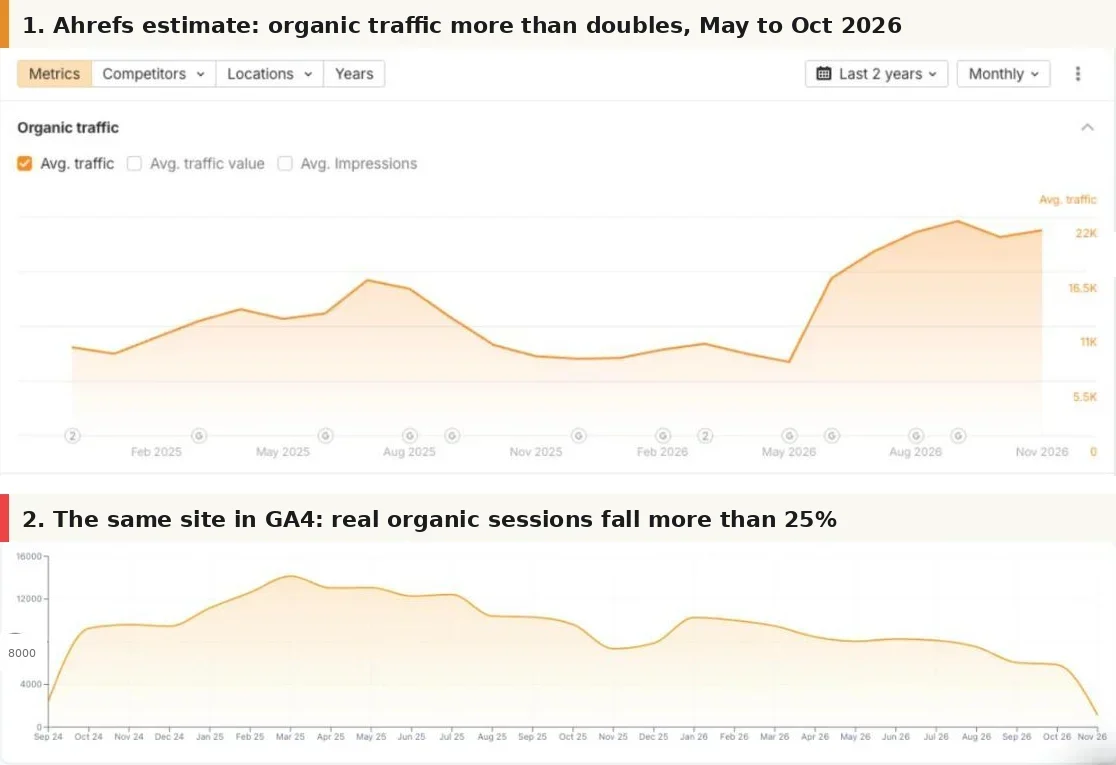
That's not a rounding error. It's the opposite direction.
If we'd reported the Ahrefs line, we'd have been celebrating a campaign while the client lost leads. If we'd forecast from it, we'd have promised growth from a peak that never happened.
And it's not just us. Other agency owners replied to the post with the same experience.
How SEO Tools Estimate Traffic
Ahrefs and Semrush don't see your traffic. They estimate it. For every keyword a site ranks for, they multiply the keyword's monthly search volume by the share of clicks that ranking position usually gets, then add it all up.
| Input | Where the tool gets it | What can go wrong |
|---|---|---|
| Search volume | Its own keyword database | Inflated or stale volumes |
| Click rate by position | A model of how often each position gets clicked | Built before AI answers took clicks |
| Ranking | The tool’s own checks, from its servers | One location, one moment |
| Estimated traffic | Volume × click rate, summed across keywords | Every error above, added up |
That means three inputs have to be right:
- Search volume for each keyword.
- The click rate for each position.
- The ranking itself, checked from the tool's servers at some point in the month.
Get any one of them wrong and the estimate drifts. Right now, two of them are wrong in the same direction.
Why the Estimates Break in 2026
The model was built for a results page with ten blue links. That page doesn't exist for a lot of searches anymore.
What the model assumes
- ✕Ten blue links
- ✕Stable click rates by position
- ✕Volume is real people
- ✕More rankings = more visits
What’s actually happening
- ✓AI answers on many searches
- ✓Clicks nearly halve with an AI summary
- ✓Some volumes look inflated
- ✓Rankings up, clicks down
Click Rates Have Collapsed Where AI Answers Show Up
When Google shows an AI summary, far fewer people click a regular result. A tool that assumes the old click rate overstates traffic for every keyword with an AI Overview.
| Google results page | Visits with a click on a regular result |
|---|---|
| Without an AI summary | 15% |
| With an AI summary | 8% |
| Click on a link inside the AI summary | 1% |
According to Pew Research Center, users clicked a regular search result on 8% of visits to a results page with an AI summary, versus 15% without one. Only 1% clicked a link inside the summary.
That's browsing data from 900 US adults in March 2025, published July 22, 2025. In that study, 18% of searches produced an AI summary.
So a site can climb the rankings and lose clicks at the same time. The tool sees the rankings. It doesn't see the clicks.
Some Search Volumes Look Inflated
Some keywords show search volumes no real audience could produce. When the volume is inflated, the traffic estimate built on it is too.
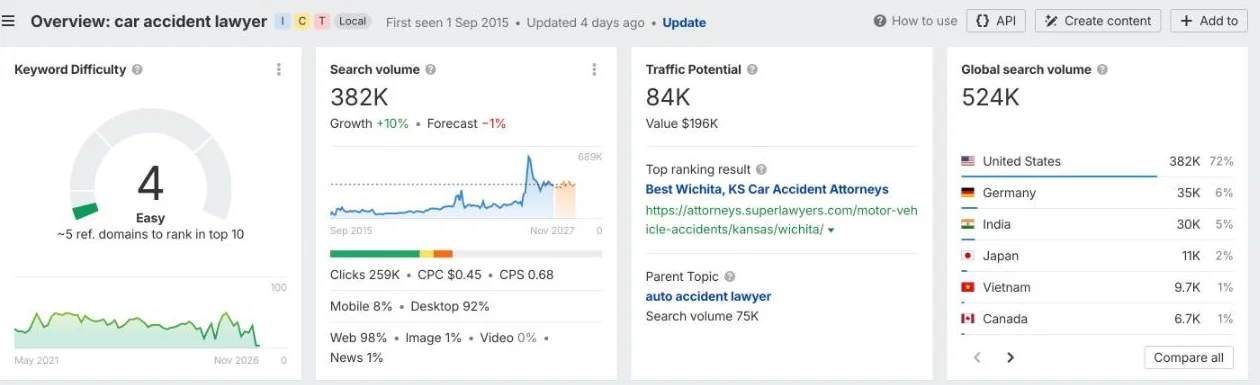
Here's "car accident lawyer" in Ahrefs on Nov 8, 2026: 382,000 searches a month, a keyword difficulty of 4 ("Easy") and a cost per click of 45 cents.
We run Google Ads for personal injury firms. That click doesn't cost 45 cents, and no firm ranks for it with five links. The trend line jumps sharply in the last year or two.
We don't know exactly what's behind spikes like this. What we do know: rank for an inflated keyword and you get the position without the traffic.
How Bad Data Hurts Campaigns
Wrong estimates don't just make reports look odd. They send campaigns in the wrong direction.
| Bad data | What happens |
|---|---|
| Inflated volume | You target keywords that never send traffic |
| Rising estimate, falling reality | Reports celebrate while the client loses leads |
| Inflated baseline | Forecasts promise growth you can’t deliver |
| Overstated competitor | You copy a rival who isn’t really winning |
- Wrong targets. You chase keywords whose volume isn't real, and the pages never pay off.
- Fake wins. A rising tool line in a client report hides a real decline until the client notices their phone stopped ringing.
- Bad forecasts. A proposal built on an inflated baseline promises growth you can't deliver.
- Wrong competitor reads. You copy a rival who looks like they're surging when they're not.
Read that again. The tool can be wrong in a way that feels like good news. That's the dangerous kind.
How to Check a Tool Against Real Data
For any site you can see inside, compare the tool's traffic line to Search Console clicks, month by month. It takes ten minutes.
- Export monthly clicks from Search Console. Performance report, Search results, the last 16 months, by date.
- Export the tool's organic traffic history for the same site and months.
- Put them side by side. Check the level, then the direction.
- Flag any month where they move in opposite directions. That's the tool drifting, not your site.
Direction matters more than level. A tool that's always 40% high is still useful for trends. A tool that goes up while clicks go down is useless for that site.
Do it for your own site first. Then a couple of clients. You'll know quickly how much to trust the tool in your niche.
AI makes this faster. Give Claude or ChatGPT both exports and ask it to flag the months where the lines disagree.
What to Use Instead
Use first-party data for anything you report or forecast, and tool data for everything else.
| Job | Use | Not |
|---|---|---|
| Client traffic and clicks | Search Console, GA4 | Tool estimates |
| Leads and conversions | GA4 key events, call tracking, CRM | Tool estimates |
| Forecasts | Search Console baseline when you can get it | An unchecked tool line |
| Competitors | Ahrefs or Semrush, labeled as estimates | |
| Keyword ideas and backlinks | Ahrefs or Semrush |
For a prospect, you won't have Search Console. Ask for it. A read-only invite takes two minutes and turns your proposal from an estimate into a diagnosis.
If they won't share it, use the tool's numbers for comparison only, label them as estimates, and use the lower number when anything disagrees. Here's how that works in an SEO ROI forecast.
Should You Still Pay for Ahrefs or Semrush?
Yes, but for what they're actually good at. They're research tools, not analytics.
Stop using them for
- ✕Client traffic reports
- ✕Forecast baselines
- ✕Proof a campaign is working
- ✕Taking volume at face value
Keep using them for
- ✓Competitor backlinks
- ✓Keyword ideas
- ✓Comparing sites with each other
- ✓Finding pages rivals built
They're still the best way to see a competitor's backlinks, find keyword ideas, compare sites with each other and spot pages a rival built that you didn't. Just stop treating their traffic numbers as facts.
If you're picking one, here's our Ahrefs vs Semrush vs Moz comparison. And here's how we now do keyword research with these limits in mind.
SEO Tool Accuracy FAQs
How accurate is Ahrefs traffic data? It's an estimate built from search volume, assumed click rates and rankings. For some sites it's close. For others it misses badly or moves in the opposite direction from real traffic. Check it against Search Console for any site you can see inside.
Is Semrush more accurate than Ahrefs? Both use the same basic method, so both share the same weaknesses: click rates that don't reflect AI answers and volumes that can be inflated. Test both against Search Console for a few sites in your niche before you decide.
Why does Ahrefs show my traffic going up when Google Analytics shows it going down? Usually because rankings improved on keywords where fewer people click, like searches with AI Overviews, or on keywords whose volume is inflated. The tool counts the rankings. Analytics counts the visits.
Should I report Ahrefs or Semrush traffic to clients? No. Report Search Console clicks and GA4 sessions. Use tool estimates only to compare a client with competitors, and label them as estimates.
What's the most accurate source of organic traffic? Google Search Console for clicks from Google, and GA4 for sessions and conversions. Neither covers competitors, which is the one job tool estimates are still for.
Report Real Data, Not Tool Estimates
Blueprint members get Agency OS, which builds every client report from Search Console and GA4, with tool data kept for what it's good at, plus the training on how to sell and deliver SEO.
Join The Blueprint Training →