

"How much should I spend on ads?"
Every prospect asks it. Most agencies answer with a number they made up.
There's no universal minimum PPC budget. Costs vary by service, location and competition. The right budget comes from the prospect's own numbers, worked backward from what a customer is worth to them.
How do you set a PPC budget? Start from what a new customer is worth and what the prospect can pay to get one. Then use their close rate, their capacity and the risk they can take to size a budget big enough to produce real leads, and never propose one above their target cost per customer.
Here's the short version:
- Get five numbers on the discovery call before you propose any budget.
- Build the equation: budget ÷ cost per click → leads → customers → cost per customer.
- Price clicks off a keyword table, at the high end of Google's top-of-page bids.
- Make sure the budget can teach you something. Two leads can't.
- Google can spend up to 2x the daily budget on a given day, but never more than 30.4x it in a month.
A made-up budget
- ✕“Most clients spend $3,000”
- ✕An industry average
- ✕A % of revenue
A budget from their numbers
- ✓What a customer is worth
- ✓What they close
- ✓What they can risk
How Much Should a PPC Budget Be?
Enough to produce useful information, and no more than the prospect can afford to risk.
That's it. A budget isn't a percentage of revenue or an industry average. It's the output of the prospect's numbers.
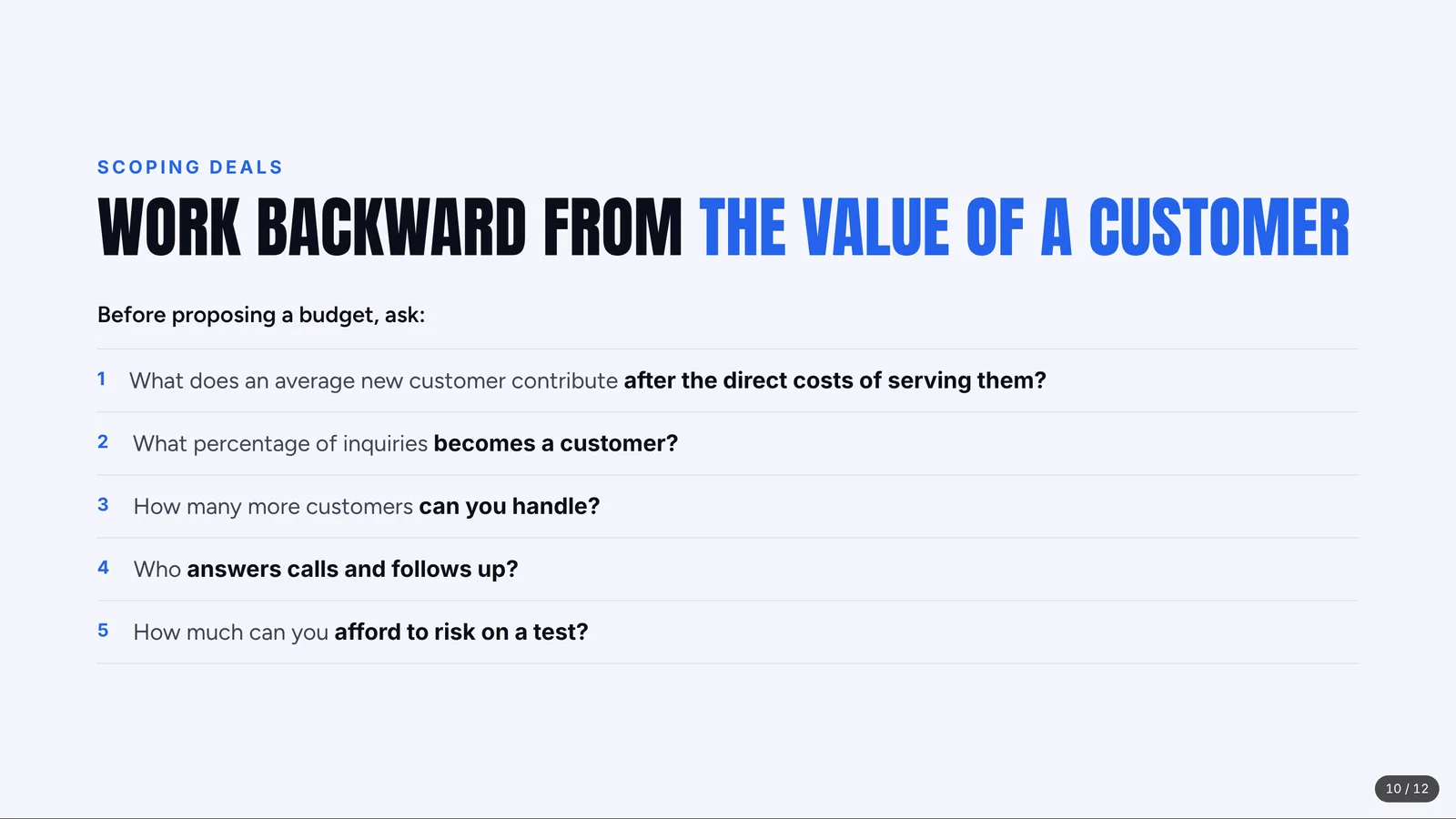
The 5 Numbers to Get Before You Propose a Budget
Ask these on the discovery call. They tell you what the prospect can pay per customer, and whether a paid search test is worth running at all.
1. What Does a New Customer Contribute?
After the direct costs of serving them. This sets the ceiling on what they can pay for a customer.
2. What Percentage of Inquiries Become Customers?
Their close rate. Pressure-test it. Most businesses think they close more than they do.
| Close rate | Customers from 20 leads |
|---|---|
| 25% (what they say) | 5 |
| 15% | 3 |
| 10% | 2 |
3. How Many More Customers Can They Handle?
Per month. If the answer is "unlimited," ask for a real number. Unlimited customers means an unlimited budget.
“Unlimited”
- ✕No real cap
- ✕Means an unlimited budget
- ✕Can’t plan capacity
A real number
- ✓“10 more a month”
- ✓Caps the budget
- ✓Sets the target
4. Who Answers the Calls and Follows Up?
Including missed calls and weekends. If the owner takes every call himself, fix intake before you launch.
Owner takes every call
- ✕Missed calls
- ✕Slow callbacks
- ✕Leads look bad
Someone owns intake
- ✓Every call answered
- ✓Fast follow-up
- ✓Leads you can measure
5. How Much Can They Afford to Risk on a Test?
The budget they can lose without it hurting the business. That's the cap on your first month.
Turn the Numbers Into a Budget
Now build the equation:
Ad budget ÷ cost per click → clicks × landing page rate → leads × close rate → cost per customer.
Here's a real forecast from one of our paid search proposals:
- $5,000 budget at about $16 per click = 308 clicks
- × 20% landing page conversion = 62 leads
- × 15% close rate = 9.2 customers
- $541 per customer, against an $800 target
Compare the result to what a customer is worth. Never propose a budget that lands above their target cost per customer. The full method is in how to build a PPC proposal.
Price Clicks at the High End
Don't use one blended click price. Price each keyword from Google Keyword Planner, and use the high end of the top-of-page bid range, which Google describes as roughly the 80th percentile of what advertisers paid.
The low end is what second place pays.
Source: Google Ads Help, About Keyword Planner forecasts.
| Keyword Planner column | What it approximates | Use it for |
|---|---|---|
| Top of page bid (low range) | 20th percentile | Nothing. That’s second place. |
| Top of page bid (high range) | 80th percentile | Your planning cost per click |
Can the Budget Teach You Anything?
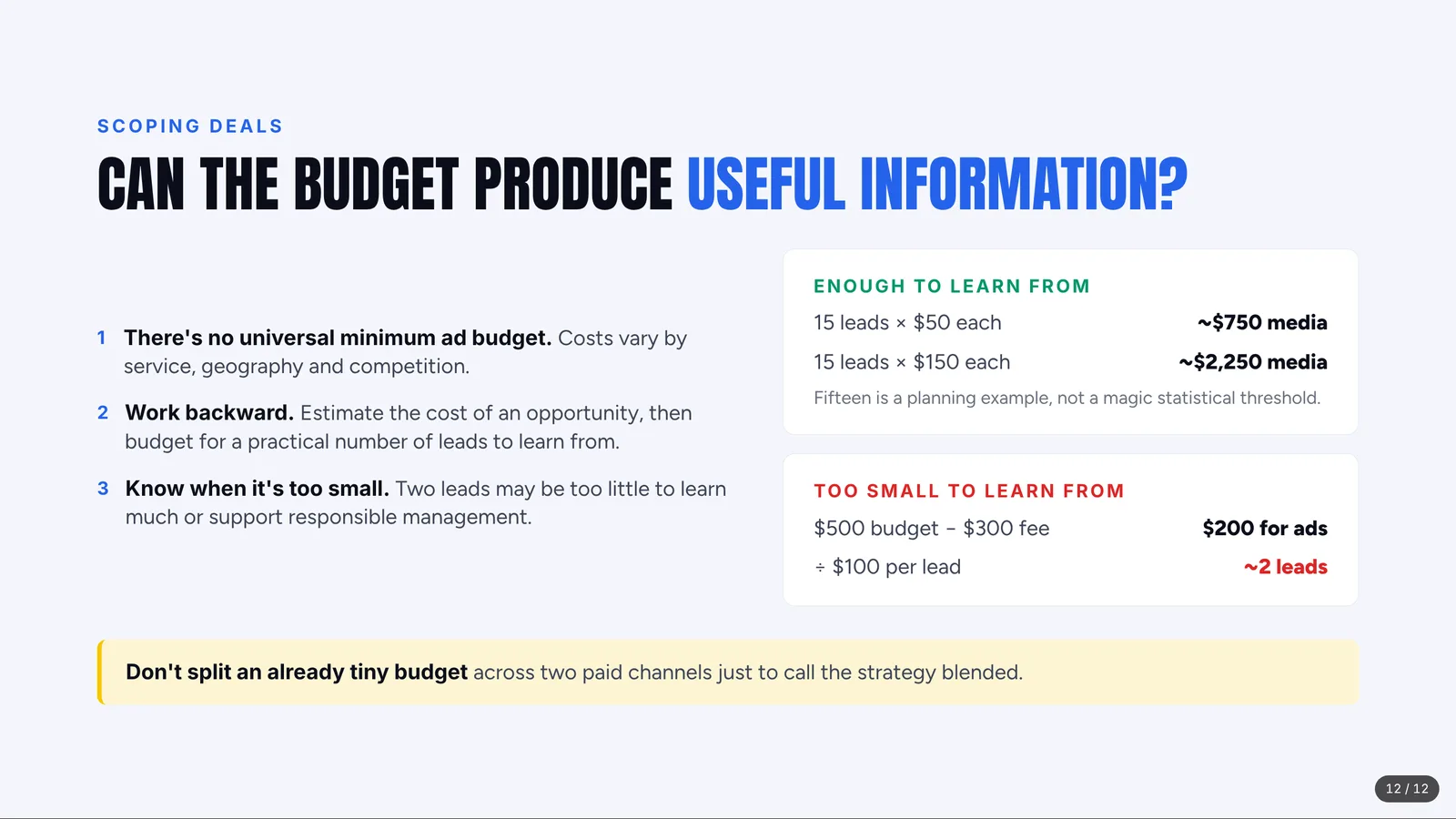
A budget has to buy enough leads to learn from. Work backward from the cost of a lead.
- Enough to learn from: 15 leads × $50 each ≈ $750 in media. 15 leads × $150 each ≈ $2,250.
- Too small to learn from: a $500 budget minus a $300 fee leaves $200 for ads. At $100 a lead, that's about 2 leads.
Fifteen is a planning example, not a magic number. And don't split a tiny budget across two channels just to call it blended.
How Google Ads Spends a Budget
Google Ads budgets are an average daily budget, not a hard daily cap.
- On a given day, a campaign can spend up to twice the average daily budget to catch traffic swings.
- Over a month, it never spends more than 30.4 times the average daily budget.
So a $100 daily budget can spend $200 on a busy Tuesday, but no more than $3,040 for the month. Explain that before the first invoice, not after.
Source: Google Ads Help, About overdelivery and your average daily budget, checked Nov 7, 2026.
Budgets for Local Services Ads
LSAs work differently. You pay per valid lead, set an average weekly budget, and Google never spends past the monthly max.
That makes LSAs the easiest first test for a small local budget. More in how to sell Local Service Ads to your clients.
How We Set Budgets in Agency OS
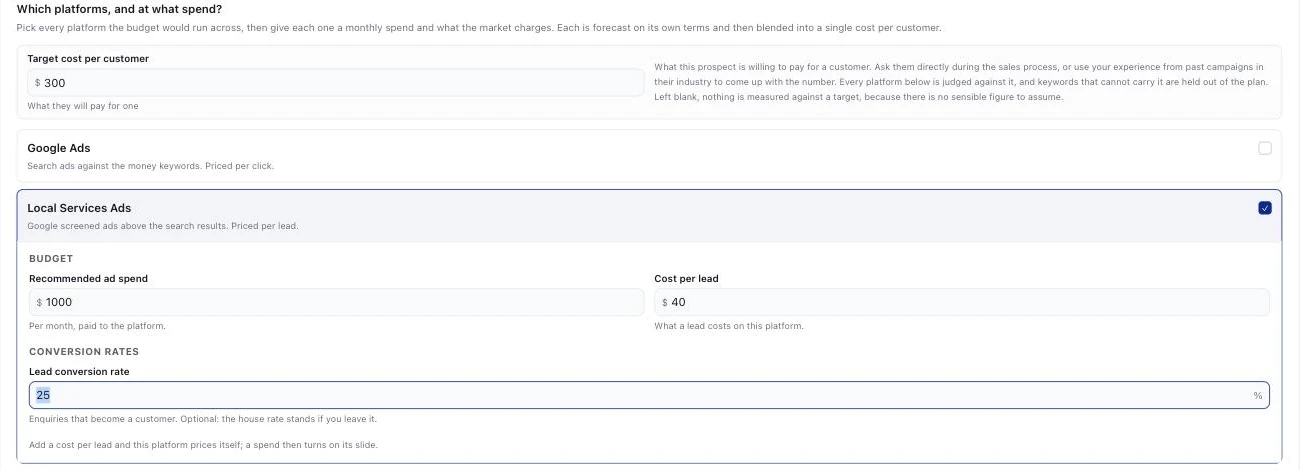
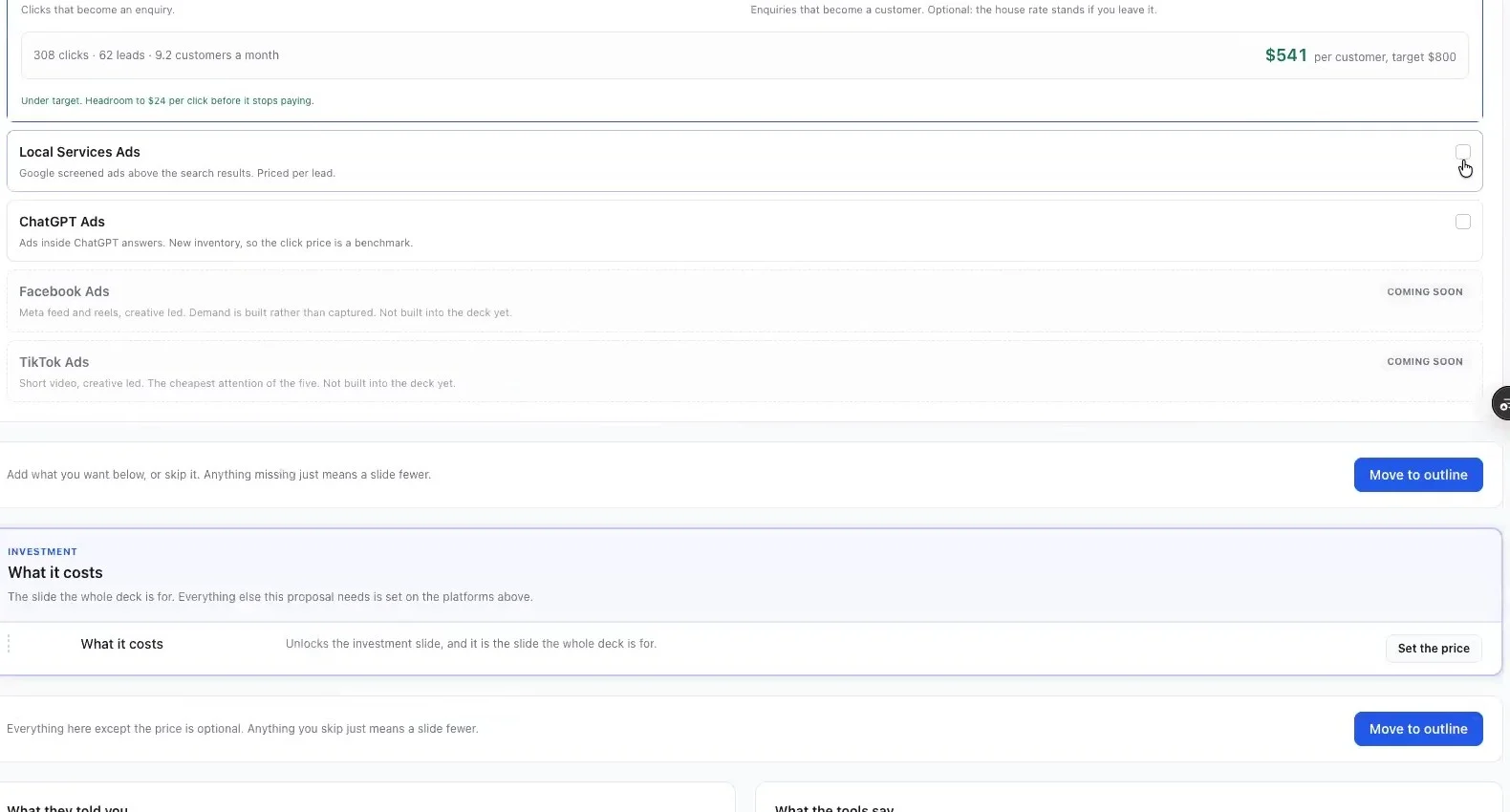
The PPC Proposal Builder in Agency OS starts with the target cost per customer. Add the spend for each platform and the forecast shows leads, customers and cost per customer, live.
Under target, it shows how much headroom you have per click. Over target, you cut keywords or lower the budget before you send it. Step by step: building a PPC proposal.
PPC Budget Mistakes
- ❌ Proposing a budget before you have the five numbers.
- ❌ Pricing clicks at the low bid.
- ❌ One blended click price for every keyword.
- ❌ Trusting the close rate they quote without pressure-testing it.
- ❌ A budget too small to learn from.
- ❌ Splitting a tiny budget across two channels.
- ❌ Surprising them with a 2x day they didn't know could happen.
- ✕No five numbers
- ✕Pricing at the low bid
- ✕One blended click price
- ✕Trusting the quoted close rate
- ✕Too small to learn from
- ✕Splitting a tiny budget
- ✕Surprise 2x days
PPC Budget FAQs
How much should a PPC budget be? There's no universal minimum. Work backward from what a customer is worth, the close rate and the cost per lead, and make sure the budget buys enough leads to learn from without exceeding what the prospect can afford to risk.
What's a good starting PPC budget for a small business? One that buys a useful number of leads. At $50 a lead, 15 leads is about $750 in media. If the cost per lead is $150, the same test is about $2,250.
Can Google Ads spend more than my daily budget? Yes, up to twice the average daily budget on a given day. Over the month, Google charges no more than 30.4 times the average daily budget.
What numbers do you need to set a PPC budget? What a new customer contributes, the close rate, how many more customers they can handle, who answers the calls, and how much they can afford to risk on a test.
Should an agency split a small budget between Google and Meta? No. A small budget split two ways teaches you nothing on either channel. Prove one channel first.
Sell Paid Search With Numbers
Blueprint members get the Selling Paid Search training and Agency OS with the PPC Proposal Builder, forecast and reporting built in.
Join The Blueprint Training →