

Paid search has one big advantage over SEO when you're selling it.
You can put an equation in front of the prospect. Spend this. Get these clicks. These become leads. This many become customers. Here's what each customer costs you.
When you can build that equation, PPC is easy to sell. When you can't, you're asking a business owner to hand you $10,000 a month on faith.
Here's the exact way we build PPC proposals at WEBRIS, the template we use, how we price PPC management, and how Agency OS builds the forecast for us.
Here's the short version:
- Sell the cost per customer, not the ad spend.
- Get five numbers on the discovery call before you propose a budget.
- Build the forecast: budget ÷ cost per click → clicks × landing page rate → leads × close rate → cost per customer.
- Plan on the high end of Google's top-of-page bid range, priced off a keyword table.
- Never send a proposal above their target cost per customer.
- Charge a flat retainer plus a percentage of spend above a threshold.
What scares them
- ✕"$20,000 a month in ad spend"
- ✕A list of campaigns
- ✕CPC and CTR jargon
What they say yes to
- ✓"$541 per new client"
- ✓Against their $800 target
- ✓One clear decision
What Is a PPC Proposal?
A PPC proposal is the document an agency sends a prospect to recommend a paid search budget, show what that budget should produce, and lay out the plan and the price.
A weak PPC proposal leads with ad spend and a list of campaigns.
A strong one leads with what each new customer will cost. That's the number the business owner actually cares about, and it's the number they can say yes to.
Sell the Cost Per Customer, Not the Ad Spend
"$20,000 a month in ad spend" scares people.
"You'll pay about $541 for each new client. Your target is $800. In or out?" is an easy decision.
So every PPC proposal starts with one question: what are you willing to pay for a new customer?
That number decides whether paid search is a fit at all. If they'd pay $800 and the math says $1,600, you just saved both of you a bad month.
The 5 Numbers to Get Before You Propose a Budget
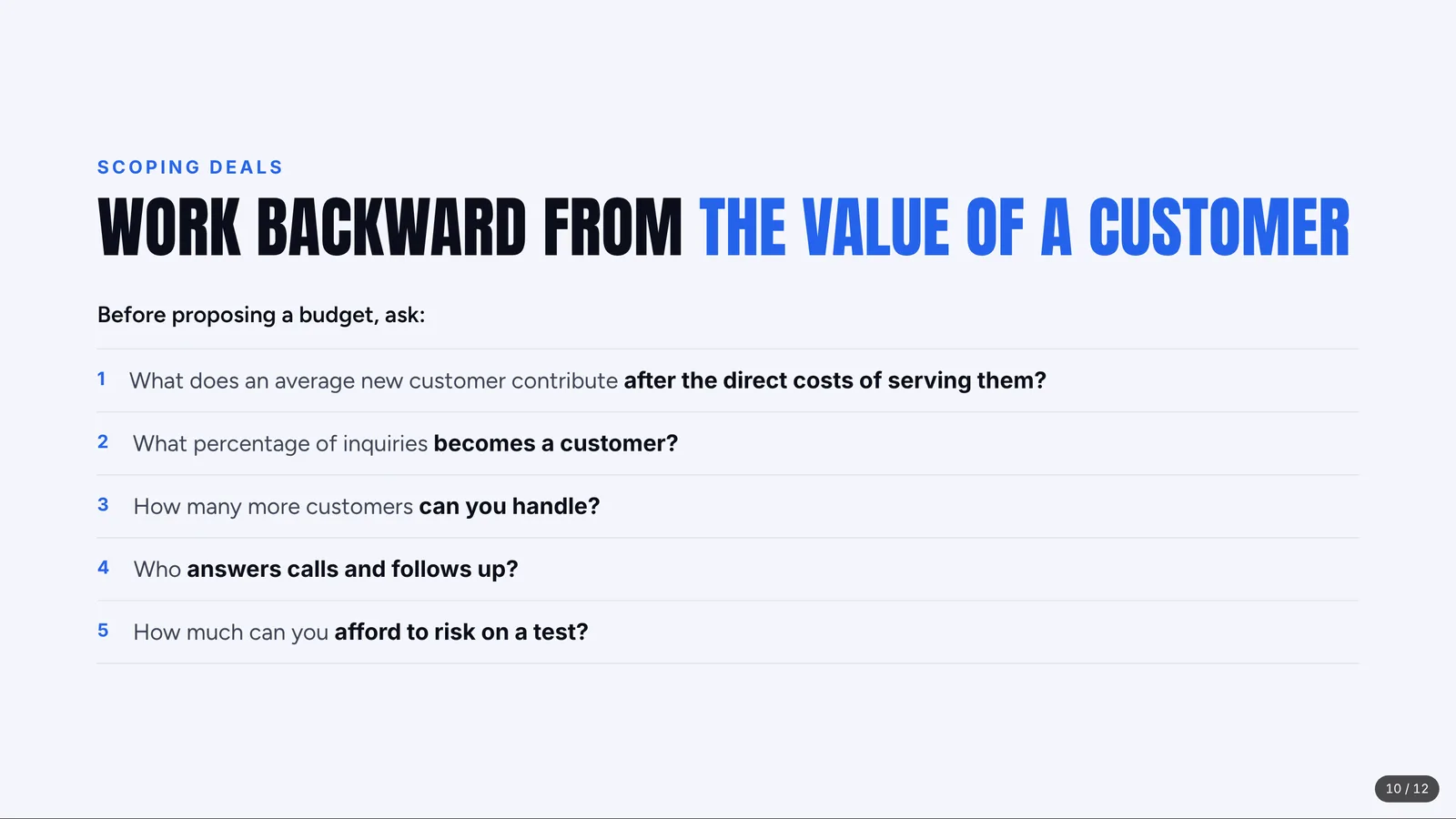
Ask these on the discovery call. They come straight from our paid search training:
- What does a new customer contribute after the direct costs of serving them?
- What percentage of inquiries become customers?
- How many more customers can you handle each month?
- Who answers the calls and follows up?
- How much can you afford to risk on a test?
Don't know their numbers? Use what you know from similar clients.
That's why picking a niche pays off. You walk in already knowing the economics. More on that in 3 agency niches that generate millions.
Pressure-Test the Close Rate
Most businesses think they close more than they do.
Ask how they track it. Ask for last month's numbers.
If they say "about half," model it lower. We forecast below whatever the client quotes, so the proposal survives a bad month.
| Close rate | Clients from 62 leads | Cost per client on $5,000 |
|---|---|---|
| 15% (what they told you) | 9.2 | $541 |
| 10% | 6.2 | $806 |
| 5% | 3.1 | $1,613 |
Ask Who Answers the Phone
If the owner takes every lead himself, he'll burn out on the bad ones and blame you.
Missed calls, weekends, slow callbacks: that's where paid leads die. Fix intake before you launch, or you'll lose the account in month three for a problem that isn't yours.
Owner takes every call
- ✕Misses calls
- ✕Burns out on bad leads
- ✕Blames the agency
Someone owns intake
- ✓Every call answered
- ✓Fast callbacks
- ✓Leads you can measure
Build the Cost-Per-Customer Equation
This is the core of the proposal. Five inputs, one answer.
Budget ÷ cost per click = clicks. Clicks × landing page conversion rate = leads. Leads × close rate = customers. Budget ÷ customers = cost per customer.
Then compare it to their target.
Use the High End of the Top-of-Page Bid
Your cost per click comes from 10 minutes in Google Keyword Planner.
Keyword Planner gives two numbers for every keyword. According to Google Ads Help, the top-of-page bid (high range) approximates the 80th percentile of what advertisers have paid for a top-of-page position. The low range approximates the 20th percentile.
Plan on the high range. In competitive local markets, if you're not the first ad, people click the first ad. The low end is what you pay to show up second.
| Keyword Planner column | What it approximates | Use it for |
|---|---|---|
| Top of page bid (low range) | 20th percentile of what advertisers paid | Nothing. That’s second place. |
| Top of page bid (high range) | 80th percentile | Your planning cost per click |
Price It Off a Keyword Table, Not One Blended CPC
"Car accident lawyer" and "slip and fall lawyer" are not the same auction. One blended click price hides that.
Build a table: keyword, monthly searches, top-of-page high bid. Strip out irrelevant terms and anything with a crazy bid. Then use a volume-weighted click price across the table.
And label every click price as "per click." You don't want a $45 click price read as a $45 lead.
| Keyword | Monthly searches | Top-of-page high bid (per click) | Keep? |
|---|---|---|---|
| [ready-to-hire keyword 1] | [from Keyword Planner] | [$ per click] | ✓ |
| [ready-to-hire keyword 2] | [from Keyword Planner] | [$ per click] | ✓ |
| [research keyword] | [from Keyword Planner] | [$ per click] | ✕ |
| Volume-weighted price | [$ per click] |
A Worked Example
An immigration law firm wants to pay $800 per new client.
Here's the forecast from a real proposal:
- $5,000 a month in Google Ads
- About $16 per click → 308 clicks
- 20% landing page conversion → 62 leads
- 15% close rate → 9.2 new clients
- $541 per client. Under the $800 target.
Now change one number. At a 5% close rate, the same spend produces about 3 clients, and the cost jumps to roughly $1,600 per client. Double their target.
The close rate matters as much as the click price.
Never Send a Proposal Above Their Target
If the math doesn't work, don't send it.
Cut the expensive keywords. Tighten the locations.
Lower the budget to a real test. Or tell them paid search isn't a fit yet.
A proposal you know will miss the target is a refund request with a delay.
- ?Cut the expensive keywordsStrip crazy bids first
- ?Tighten the locationsFewer, better areas
- ?Lower to a real testEnough leads to learn from
- ?Or say it’s not a fit yetBetter than a refund in month two
Run the Downside Case
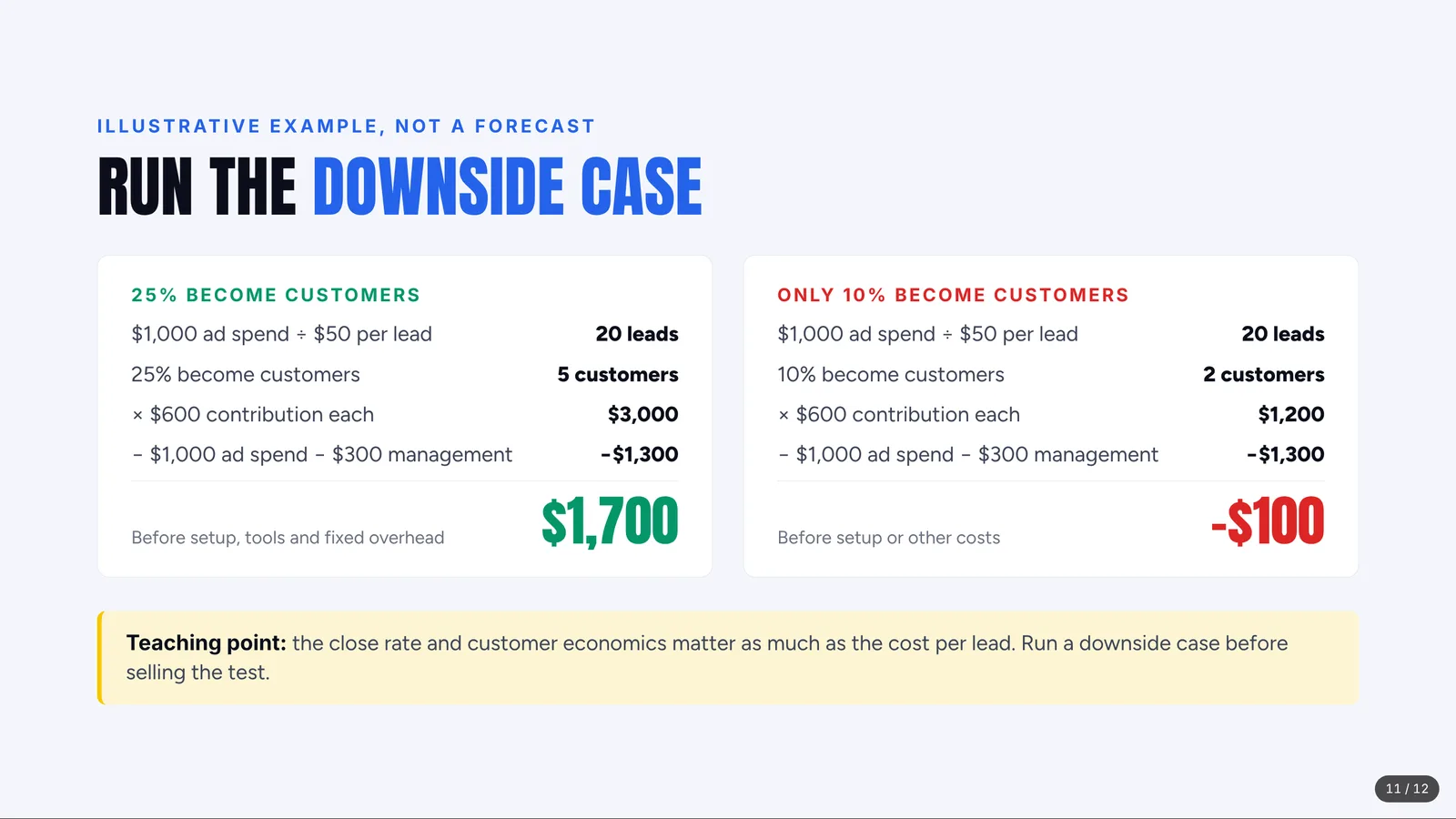
Before you sell a test, show what happens if their sales process is weaker than they think.
Same $1,000 in spend, $50 per lead, 20 leads, $600 contribution per customer:
- 25% become customers: 5 customers, +$1,700 after spend and a $300 fee.
- 10% become customers: 2 customers, -$100.
Showing this up front builds trust. It also protects you when the leads come in and they don't close them.
Know When the Budget Is Too Small to Learn Anything
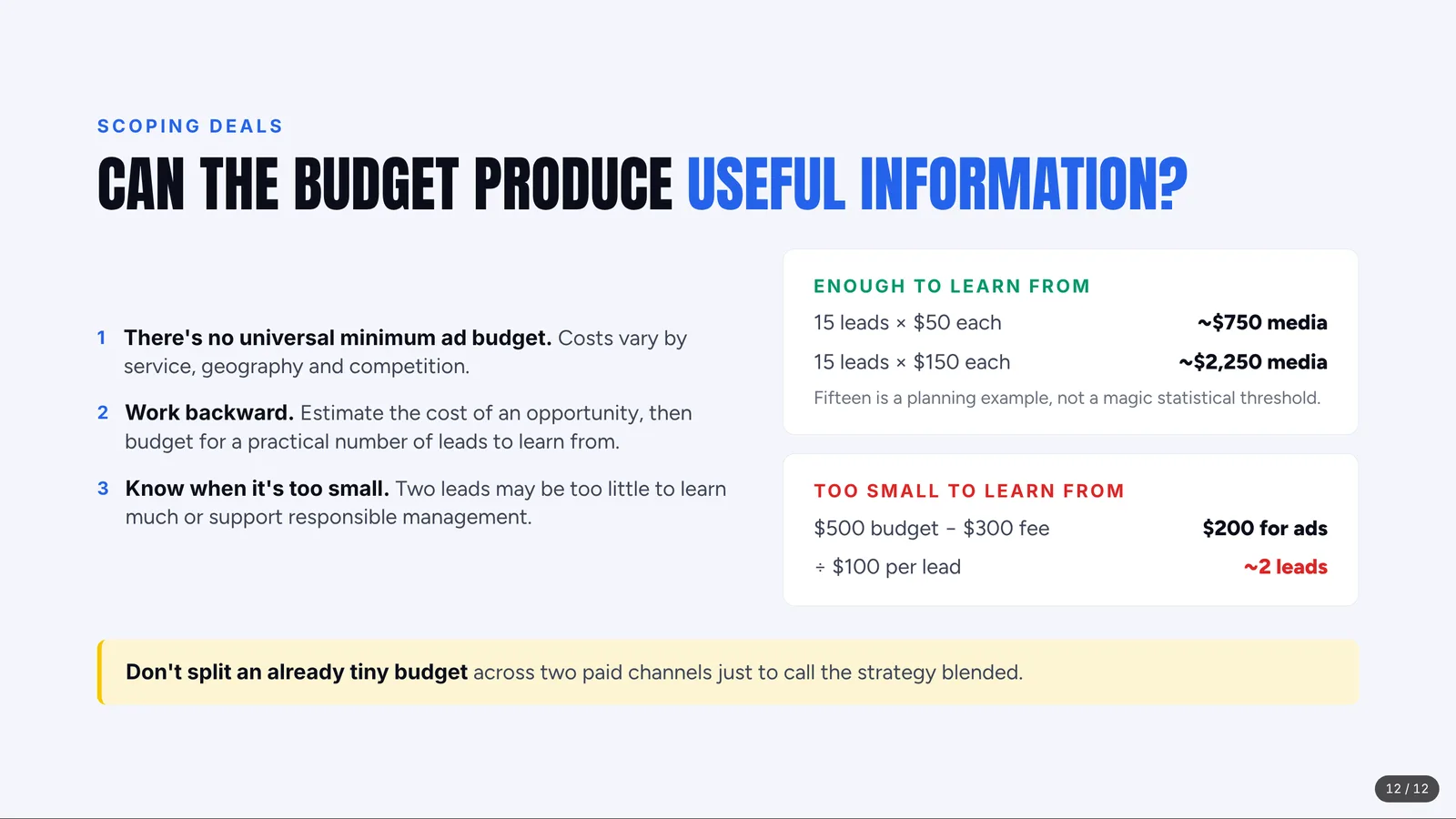
There's no universal minimum ad budget. Costs vary by service, location and competition.
Work backward. Estimate the cost of a lead, then budget for enough leads to learn from.
Fifteen leads at $50 is about $750 in media. Fifteen at $150 is about $2,250.
A $500 budget minus a $300 fee leaves $200 for ads. At $100 a lead, that's two leads. That's not a test. And don't split a tiny budget across two channels just to call it a strategy.
PPC Proposal Template: What Goes in Each Section
Here's the structure we use, section by section. Swap in your prospect's numbers and you have a draft.
| # | Section | What goes in it |
|---|---|---|
| 1 | Executive summary | Target vs. forecast cost per customer, recommended spend |
| 2 | Account audit | Only if they already run ads |
| 3 | Keyword research by intent | Ready to hire vs. still comparing |
| 4 | Cost per customer by channel | Google Ads, LSAs, anything proven |
| 5 | Placements, timeline, reporting | Where ads show, months 1–3, the dashboard |
| 6 | Scope and pricing | One price, explained simply |
Executive Summary and Recommended Spend
One page. The target cost per customer, the forecast cost per customer, and the total monthly spend you recommend.
If the forecast beats the target, say it in the first sentence. That's the headline.
Account Audit (If They Already Run Ads)
If they're already spending, a short audit is the best conversation piece you have.
One example from a real audit: branded campaigns made the cost per lead look like $70. With brand stripped out, the real number was $94. The prospect had been reading the wrong number for a year.
Is the audit required? No.
You'll rebuild the account your way anyway, and chasing account access slows the deal down. Skip it if access is a hassle.
Keyword Research by Intent
Split the keywords into who's ready to hire ("car accident lawyer near me") and who's still comparing ("how much does a lawyer cost"). Budget goes to ready-to-hire first.
This is the same keyword research process we use for SEO, pointed at money.
Still comparing
- ✕"how much does a lawyer cost"
- ✕"do I need a lawyer"
- ✕Lower budget priority
Ready to hire
- ✓"car accident lawyer near me"
- ✓"immigration attorney [city]"
- ✓Budget goes here first
Cost Per Customer by Channel
The section to spend the most time on in the pitch.
Show the forecast for each platform separately: Google Ads, Local Service Ads, and anything newer only if your data says it works. One line per channel, one cost per customer each.
| Channel | How you pay | What you forecast |
|---|---|---|
| Google Ads | Per click | Clicks → leads → customers |
| Local Service Ads | Per valid lead | Leads → customers |
| Newer channels | Varies | Only if your data says it works |
Placements, Timeline and Reporting
Show where the ads appear, what happens in month one, two and three, and what they'll see in reporting.
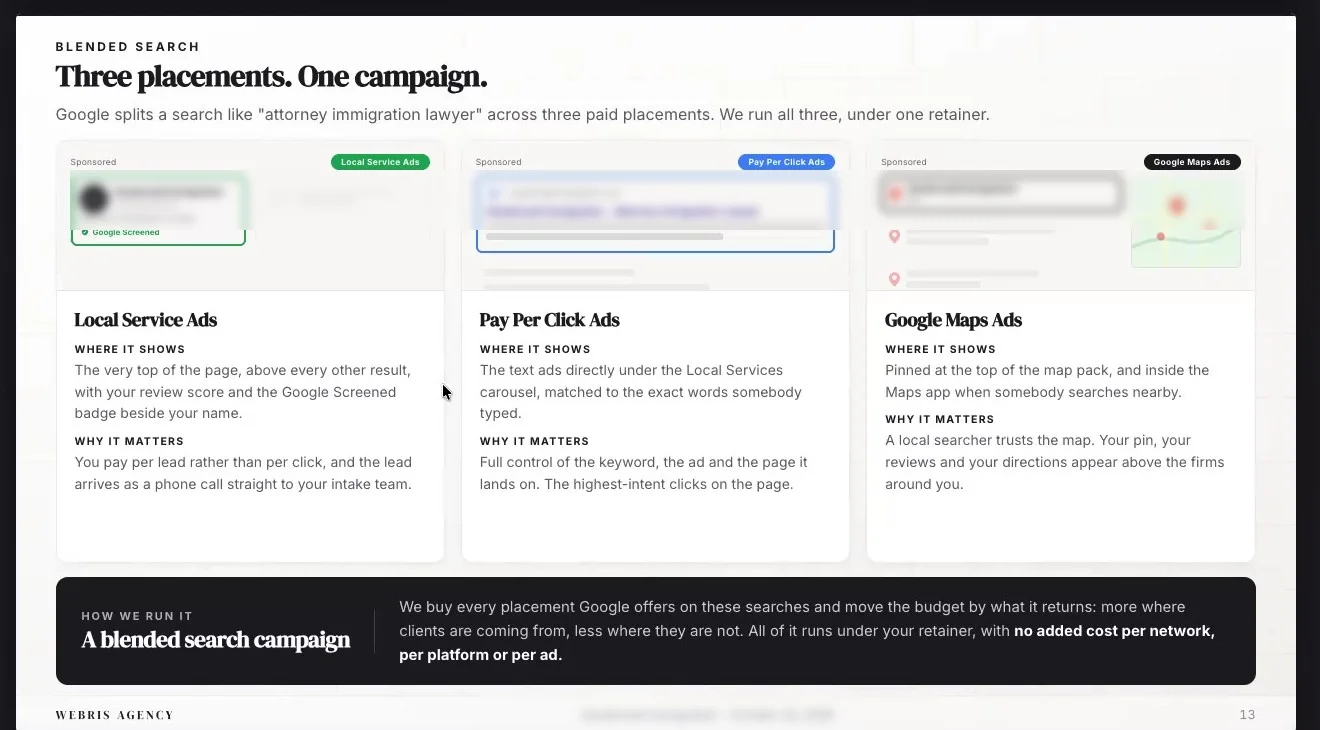
Here's the placements slide from a real WEBRIS proposal. Google splits a search like "attorney immigration lawyer" across three paid placements: Local Service Ads, pay per click ads and Google Maps ads. We run all three under one retainer.
Scope and Pricing
One price, explained simply. How we land on it is next.
- ✓One monthly retainerNot per campaign, not per platform
- ✓% of spend above a thresholdSo the fee scales with the account
- ✓Optional setup feeOnly if the build is heavy
How to Price PPC Management
There are three ways to charge for PPC management: a flat fee, a percentage of ad spend, or both.
| Model | How it works | The catch |
|---|---|---|
| Flat fee | One number, whatever the budget | Underpaid when the account scales |
| % of ad spend | Fee moves with the media | Underpaid on small accounts |
| Flat + % | Retainer, then a share above a threshold | Two numbers to explain |
What We Charge: A Flat Retainer Plus a Percentage
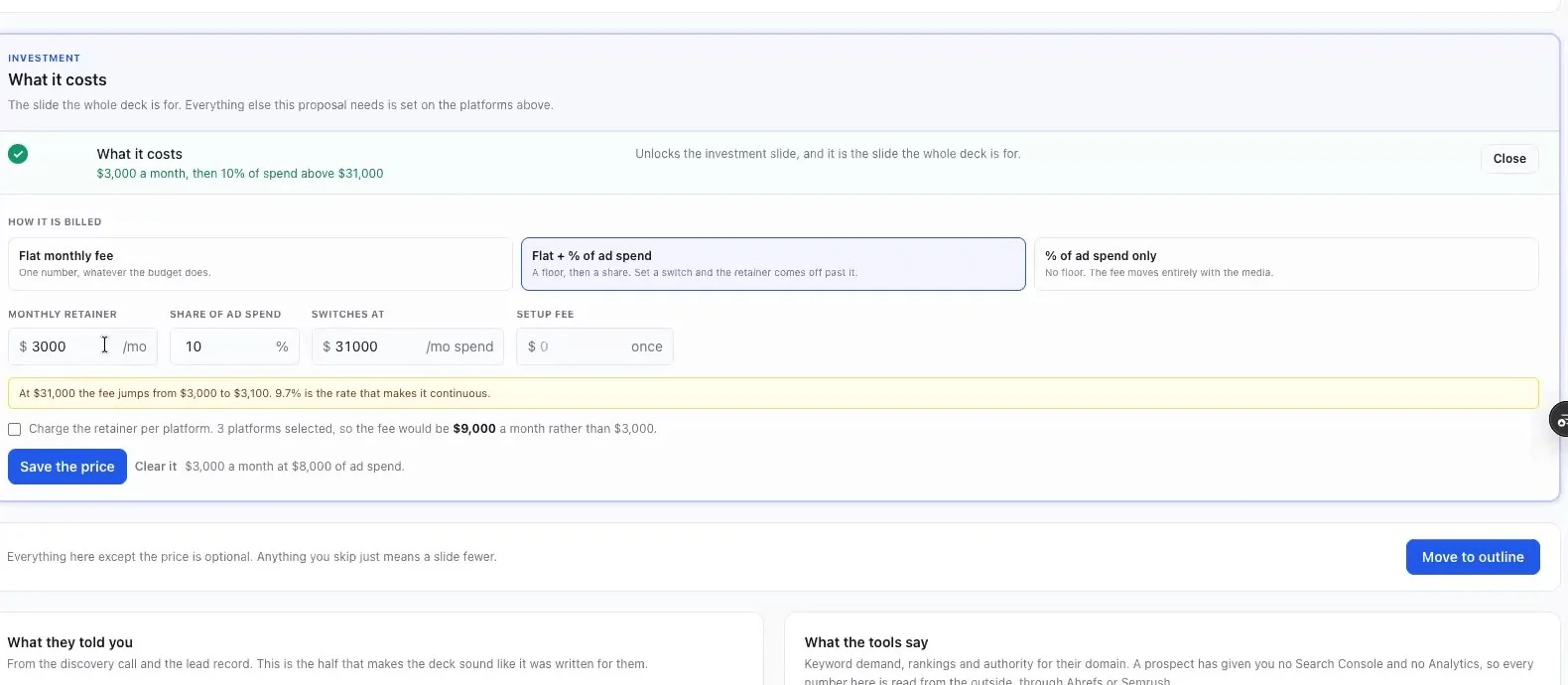
We do both. A flat monthly retainer, plus a percentage of spend once spend crosses a threshold.
A percentage on its own leaves you underpaid on small accounts. A flat fee on its own leaves you underpaid when a client scales to $50,000 a month.
One account we just closed spends $50,000 a month across platforms. Our fee is $5,000 a month.
How Much to Charge for Google Ads Management
Set three numbers: the retainer, the percentage, and the spend level where the percentage kicks in.
In the setup above: a $3,000 monthly retainer until spend passes $31,000. Past that, the retainer comes off and the fee is 10% of spend.
At $31,000, the fee steps from $3,000 to $3,100. Small enough that no client notices, and it scales from there: $50,000 in spend is a $5,000 fee.
Your retainer follows your floor, your market and their customer value. That method is in 7 SEO pricing models for agencies, and it works the same for paid.
| Monthly ad spend | Fee |
|---|---|
| $8,000 | $3,000 |
| $31,000 | $3,100 |
| $50,000 | $5,000 |
Four Pricing Rules
- ✅ Price to the niche. Lower-ticket clients can't carry a big retainer. Even running ads near break-even can be worth it if the client stays longer.
- ❌ Don't charge per campaign. Run as many as it takes.
- ❌ Don't charge per platform by default. Three platforms shouldn't triple the fee.
- ✅ Bundle with SEO when you can. Clients who buy both stay the longest. When one channel dips, the other carries it.
- ✓Price to the nicheLower-ticket clients can’t carry a big retainer
- ✓Bundle with SEOClients who buy both stay longest
- ✕Charging per campaignRun as many as it takes
- ✕Charging per platformThree platforms shouldn’t triple the fee
How to Pitch PPC on the Sales Call
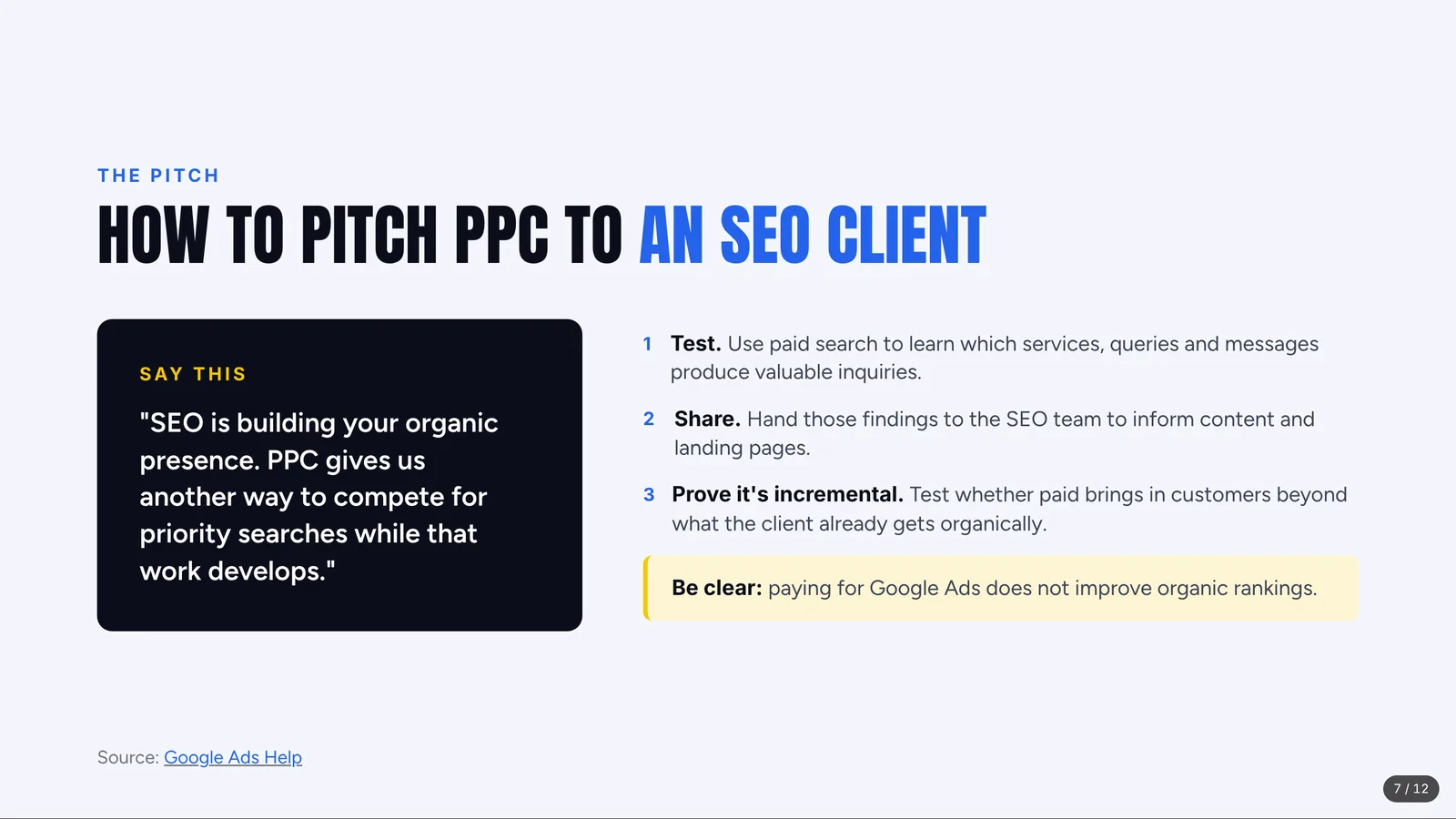
Most PPC deals start as SEO conversations. The prospect came in for SEO, and you show them the whole search page.
Position PPC as a complement to SEO, not a replacement. It gets leads in the first week while SEO builds.
The full two-call process is in how to sell SEO services without a sales rep.
Put Local Service Ads in Every Local Proposal
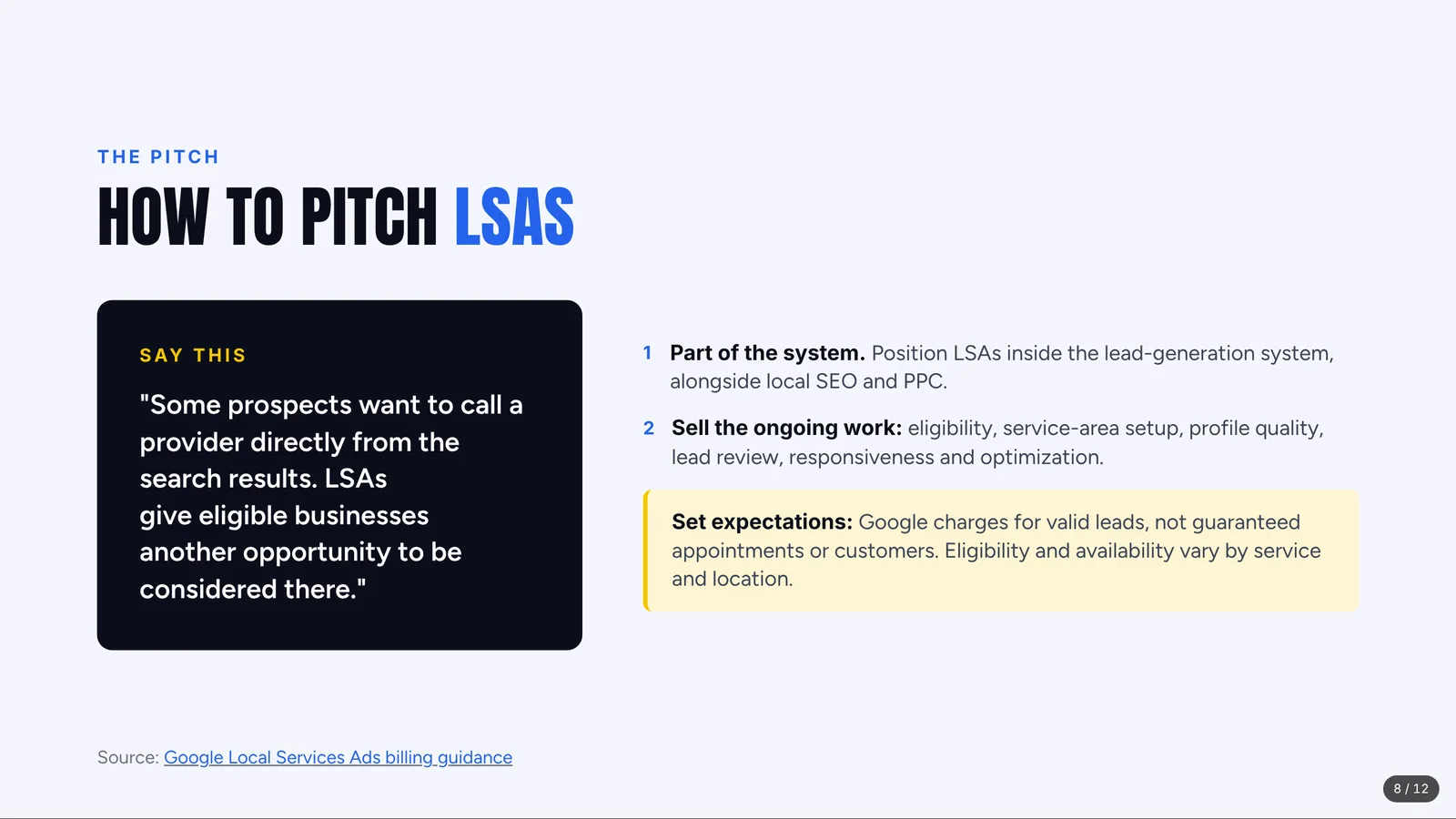
Local Service Ads sit at the very top of Google, and the client pays per lead, not per click.
Set expectations. Google says advertisers are charged for each valid lead, and leads judged invalid or low quality aren't charged. A valid lead is not a booked appointment or a signed customer.
How We Build PPC Proposals in Agency OS
The equation, the forecast and the pricing are all built into the paid search side of the Proposal Builder in Agency OS.
Start From the Target Cost Per Customer
It's the first field in the builder. Everything else is measured against it.
Pick the Platforms and Upload the Keywords
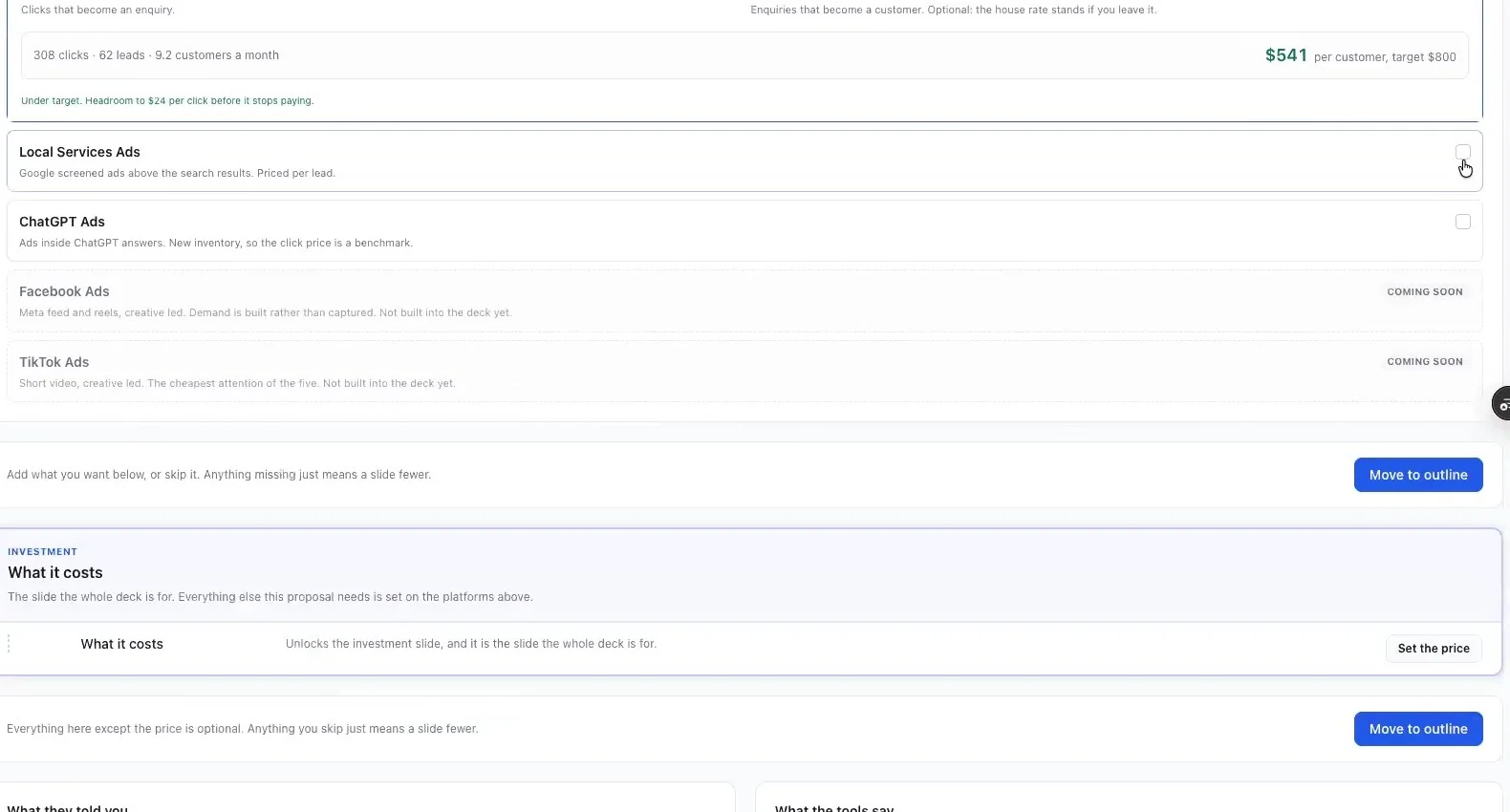
Turn on the platforms you're proposing: Google Ads, Local Service Ads and ChatGPT ads, each with its own budget and conversion rates.
Upload your Keyword Planner CSV. The forecast recalculates live as you remove keywords or change conversion rates.
Under target, it shows how much headroom you have per click before the campaign stops paying. In this one: $24 per click.
Audit an Existing Account From Exports
Already running ads? Upload their Google Ads exports: campaigns, search terms, keywords, ad groups and locations. The audit goes straight into the proposal.
No account yet? Skip it. The proposal just leaves out the audit slides.
- ✓Campaigns
- ✓Search terms
- ✓Search keywords
- ✓Ad groups
- ✓Locations
Report on It After You Win
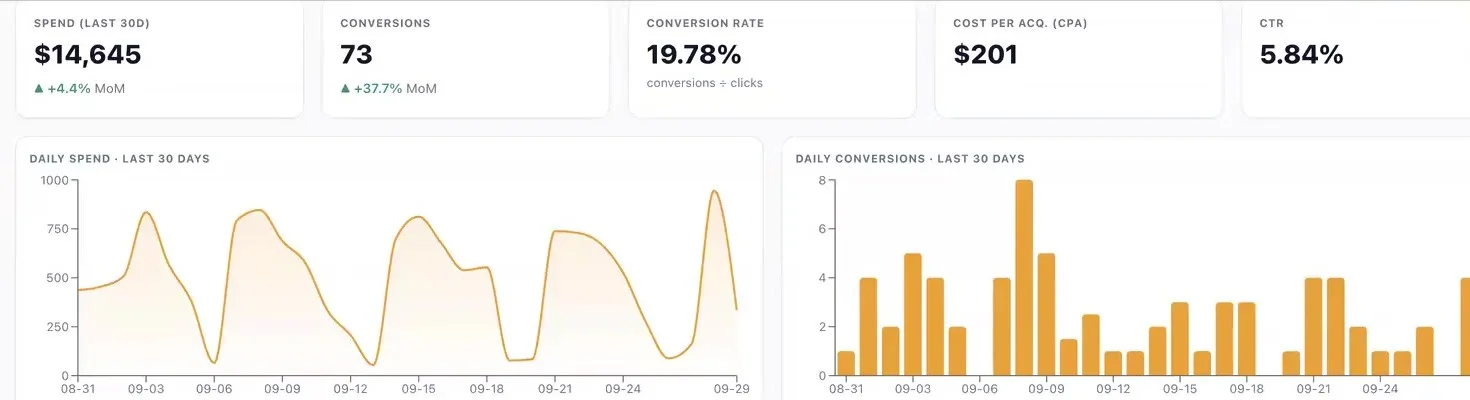
PPC and LSA reporting dashboards are already in Agency OS, and clients see them in their portal. That's live client reporting, with no spreadsheet to update.
Need SEO and paid for the same prospect? Combine both in one proposal. The SEO side is in how to build an SEO proposal.
PPC Proposal Mistakes That Lose Deals
- ❌ Leading with ad spend. Lead with cost per customer.
- ❌ Planning on the low bid. Use the high end of the top-of-page range.
- ❌ One blended click price. Price off a keyword table.
- ❌ Trusting the quoted close rate. Forecast below it.
- ❌ Sending a proposal above their target. Fix the plan or don't send it.
- ❌ A budget too small to learn from. Two leads a month isn't a test.
- ❌ Charging per campaign or per platform. It punishes the client for doing it right.
- ✕Leading with ad spend
- ✕Planning on the low bid
- ✕One blended click price
- ✕Trusting the quoted close rate
- ✕Sending above their target
- ✕A budget too small to learn from
- ✕Charging per campaign or platform
PPC Proposal FAQs
What should be included in a PPC proposal? An executive summary with recommended spend, an account audit if they already run ads, keyword research by intent, the forecast cost per customer by channel, placements, timeline, reporting, and scope and pricing.
How do you forecast results in a PPC proposal? Divide the budget by cost per click to get clicks, multiply by landing page conversion rate to get leads, then by the close rate to get customers. Compare the resulting cost per customer to the client's target.
What cost per click should you use in a PPC forecast? The high end of Keyword Planner's top-of-page bid range, priced off a table of keywords and weighted by search volume. Google describes the high range as roughly the 80th percentile of what advertisers have paid.
How much should an agency charge for PPC management? We use a flat monthly retainer plus a percentage of ad spend above a threshold. A percentage alone underpays you on smaller accounts.
What is the minimum ad budget for a PPC test? There's no universal minimum. Estimate the cost of a lead, then budget for enough leads to learn from. A budget that buys two leads a month is too small.
Is there a free PPC proposal template? Yes. The section-by-section template above is the structure we use. Blueprint members get the PPC Proposal Builder in Agency OS, which fills it in from their keywords and numbers.
Sell Paid Search With Numbers, Not Promises
Blueprint members get the PPC Proposal Builder in Agency OS, the full Selling Paid Search training, and the sales module.
Join The Blueprint Training →