

Every PPC forecast assumes the prospect closes what they say they close.
Most don't.
Same spend. Same cost per lead. Only the close rate changes. And that one number decides whether the test makes money or loses it.
How do you calculate PPC ROI? Divide ad spend by cost per lead to get leads, multiply by the close rate to get customers, multiply by what each customer contributes, then subtract ad spend and management fees. Run it twice: once at the close rate they quote, once at a weaker one.
Use the calculator below. Change any number and both outcomes update.
Here's the short version:
- PPC return = customers × contribution − (ad spend + fees).
- Run the downside case at a lower close rate before you sell the test.
- Find the break-even close rate. Below it, the test loses money.
- The close rate matters as much as the cost per lead.
How to Use the PPC ROI Calculator
Six inputs, all from the discovery call or your keyword research:
- Ad spend: the monthly media budget.
- Cost per lead: from your forecast, or the platform's estimate for LSAs.
- Contribution per customer: what a new customer is worth after the direct costs of serving them.
- Management fee: your monthly fee.
- Close rate, good case: what the prospect tells you.
- Close rate, downside: a weaker number. We start around 10%.
The result is before setup, tools and fixed overhead. It's an illustration, not a forecast.
| Input | Where it comes from |
|---|---|
| Ad spend | The monthly media budget |
| Cost per lead | Your keyword forecast or the LSA estimate |
| Contribution | Discovery call: value after direct costs |
| Management fee | What you’ll charge |
| Close rates | What they say, and a weaker number |
How PPC ROI Is Calculated
Four steps:
- Ad spend ÷ cost per lead = leads
- Leads × close rate = customers
- Customers × contribution = contribution
- Contribution − (ad spend + management fee) = net return
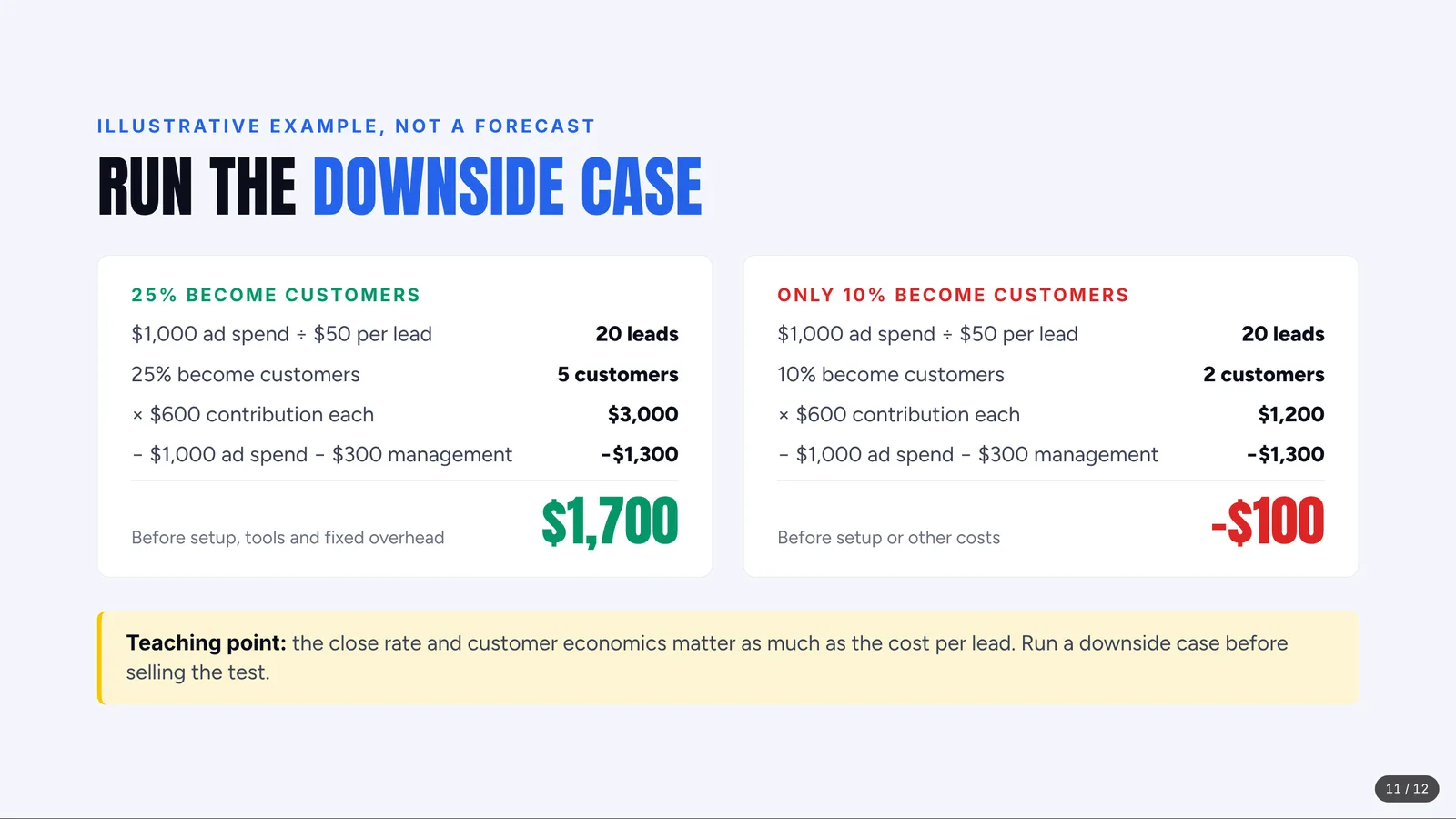
The Downside Case, Worked Through
$1,000 in ad spend at $50 a lead is 20 leads. Each customer contributes $600. The management fee is $300.
- At a 25% close rate: 5 customers, $3,000 contribution, +$1,700.
- At a 10% close rate: 2 customers, $1,200 contribution, −$100.
Read that again. Nothing changed except the close rate, and a winning test became a losing one.
Find the Break-Even Close Rate
At these numbers, the test needs $1,300 in contribution to break even. That's about 2.2 customers out of 20 leads.
Break-even is a 10.8% close rate. Below it, the test loses money.
| Close rate | Customers | Net return |
|---|---|---|
| 5% | 1 | −$700 |
| 10% | 2 | −$100 |
| 10.8% | 2.2 | $0 (break-even) |
| 15% | 3 | +$500 |
| 20% | 4 | +$1,100 |
| 25% | 5 | +$1,700 |
| 30% | 6 | +$2,300 |
Where to Get Each Number
- Cost per lead: build it from a keyword table at the high end of Google's top-of-page bids, then your landing page conversion rate. See how to set a PPC budget.
- Contribution and close rate: ask on the discovery call. See discovery call questions.
- Management fee: what you'll actually charge. See SEO pricing models.
- ✓Cost per leadKeyword table, high-end bids, landing page rate
- ✓ContributionAsked on the discovery call
- ✓Close rateAsked, then pressure-tested
- ✓FeeYour real price
Show the Prospect Both Outcomes
Put the downside case in the proposal. It builds more trust than a rosy forecast.
It also starts the right conversation: if the downside loses money, the fix is usually intake, not ads. Fix who answers the phone before you launch.
More on presenting it in how to build a PPC proposal.
Rosy forecast only
- ✕One number
- ✕Assumes their close rate
- ✕Breaks trust in month two
Both outcomes
- ✓Good case and downside
- ✓Shows break-even
- ✓Starts the intake conversation
How We Forecast in Agency OS
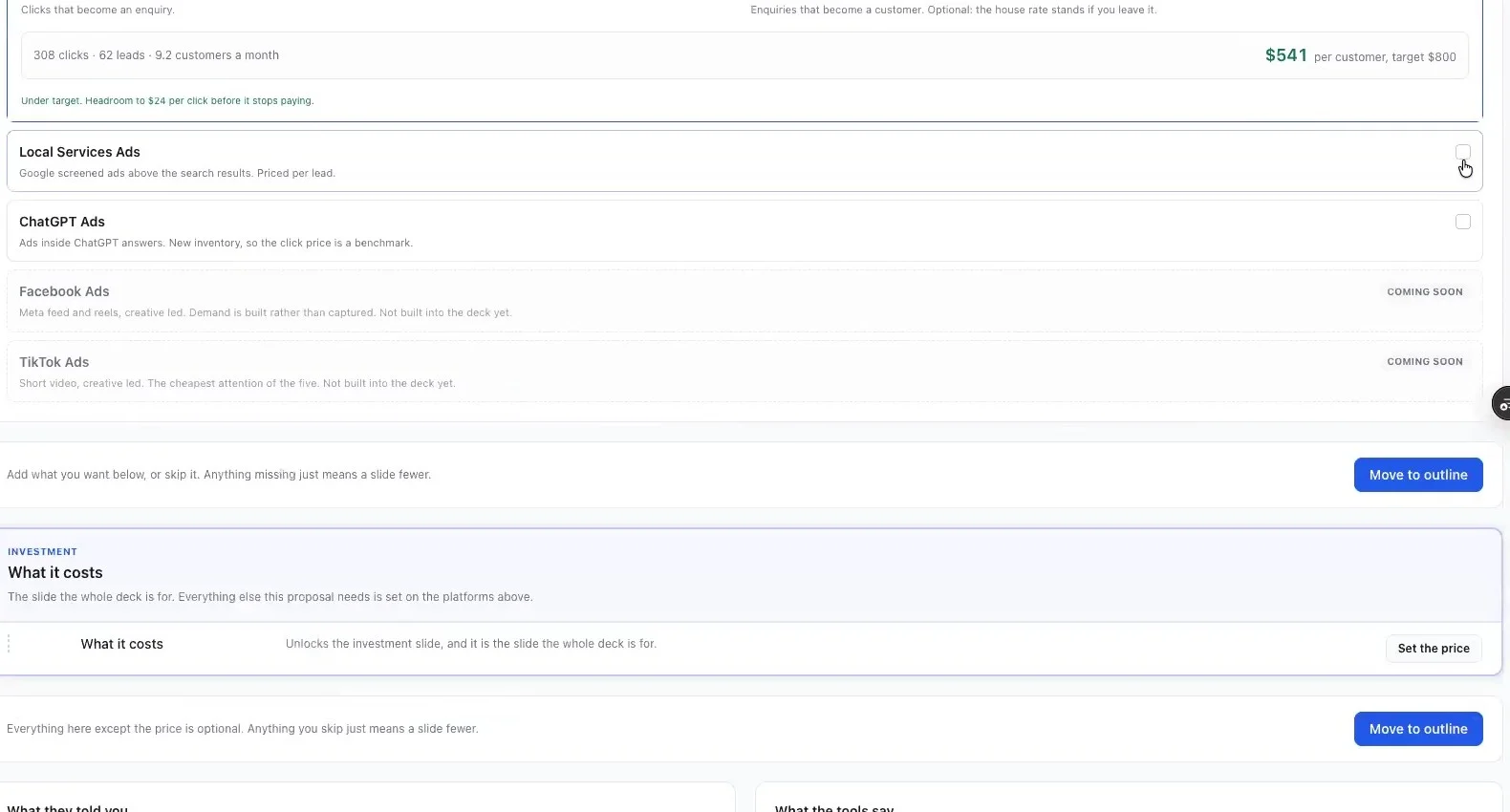
The PPC Proposal Builder in Agency OS runs the same math on every platform, against the prospect's target cost per customer. Change a close rate or a keyword and the forecast updates live.
PPC ROI Mistakes
- ❌ Forecasting only at the close rate they quote.
- ❌ Using the low bid to price clicks.
- ❌ Leaving your fee out of the math.
- ❌ Counting revenue instead of contribution.
- ❌ Calling an illustration a forecast.
- ❌ Selling the test when the downside loses money and intake isn't fixed.
- ✕Only the quoted close rate
- ✕Pricing at the low bid
- ✕Leaving your fee out
- ✕Revenue, not contribution
- ✕Illustration called a forecast
- ✕Selling a losing test
PPC ROI Calculator FAQs
How do you calculate PPC ROI? Ad spend divided by cost per lead gives leads. Leads times close rate gives customers. Customers times contribution, minus ad spend and fees, is the net return.
What is a downside case in PPC? The same forecast run at a weaker close rate than the prospect quotes. It shows whether the test still makes sense if their sales process is weaker than they think.
What's a break-even close rate? The close rate where contribution equals ad spend plus fees. At $1,000 spend, $50 per lead, $600 contribution and a $300 fee, it's about 10.8%.
Should I use revenue or contribution? Contribution: what a customer is worth after the direct costs of serving them. Revenue overstates the return.
Is this calculator a forecast? No. It's an illustration for the sales conversation. A real forecast prices clicks from a keyword table and runs per platform.
Sell Paid Search With Numbers
Blueprint members get the Selling Paid Search training and Agency OS with the PPC Proposal Builder, forecast and reporting built in.
Join The Blueprint Training →