
You don't need a sales rep to sell SEO.
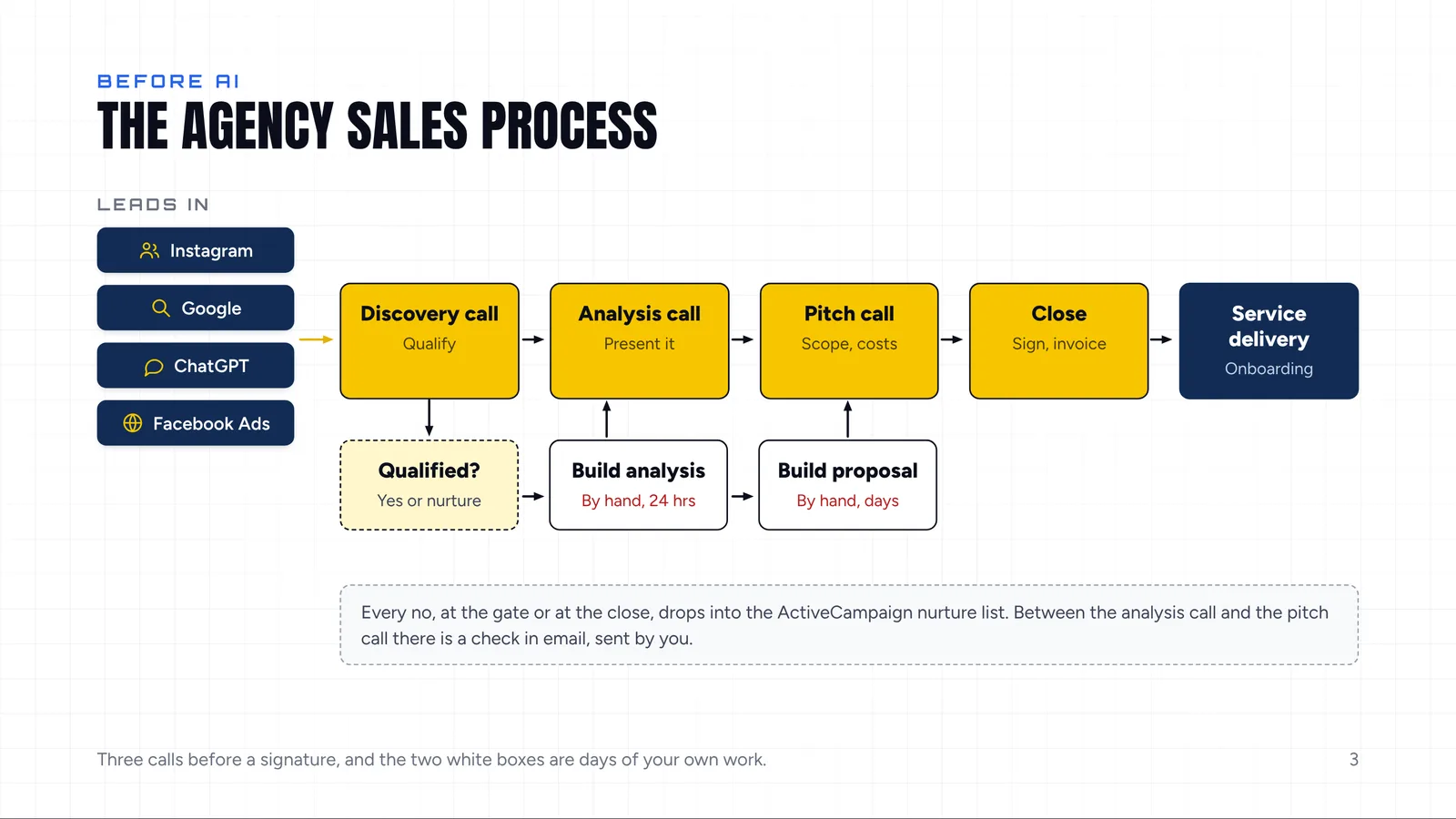
For most of my career, selling SEO meant three calls and days of work in between. A discovery call. A day building an analysis by hand.
An analysis call. Then days building a proposal.
A pitch call.
That's why agencies hire sales reps. Not for the conversations. For the busywork around them.
AI took the busywork.
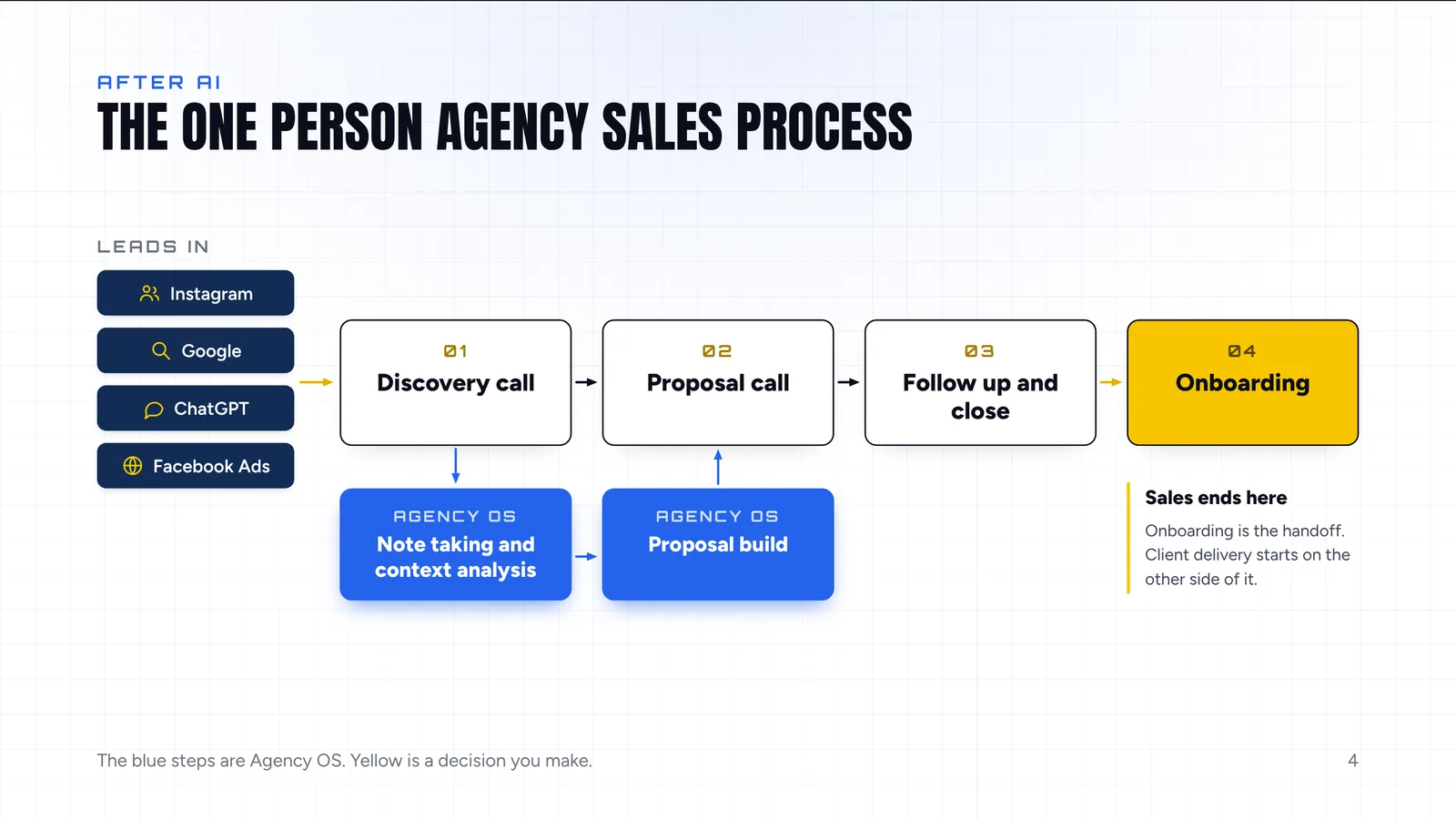
Today I run what I call the one-person agency sales team. I do the part only a human can do: the conversations. AI does everything between them:
- ✅ Logs the call recording and notes on the lead
- ✅ Pulls the data and builds the analysis
- ✅ Builds the proposal in about five minutes
- ✅ Keeps every follow-up on schedule
Read that again. The calls are the job. Everything else is software.
That's two calls instead of three. At WEBRIS, a prospect can go from booking a call to signed and onboarded in less than a workday, with no sales rep and no sales team.
I've been selling SEO for 15 years. This is the exact process we use to sell SEO services today, step by step: the booking page, the discovery call, the paid search pitch, the proposal call and the follow-up. Plus how we run all of it in Agency OS.
Here's the short version:
- You do the talking. AI does the analysis, the proposal and the follow-up schedule.
- One page, one offer, one calendar. Qualify on the booking form, not on the call.
- The discovery call finds out what they need and whether you even want them. Give a price range before you build anything.
- Don't sell "SEO." Sell the whole search page, and sell the outcome, not the channel.
- The proposal call walks the deck slide by slide, then asks for a decision date.
- Follow up personally until you get a real yes or no.
What Does It Mean to Sell SEO Services?
Selling SEO services means getting a business owner to pay you a monthly retainer for search visibility they can't see yet.
That's why it's hard. You're selling a result that shows up in months, to someone who's probably been burned by an agency before.
So the job isn't to "close." It's to find out, fast, whether you can help this business, then make the yes easy if you can. That takes a process, not a pitch:
- Qualify on the booking form.
- Discovery call to find the need, the fit and the budget.
- Proposal call to show the data and the plan.
- Follow up until you get a real answer.
Get the jobs straight first. Marketing generates interest. Sales turns it into clients.
If your pipeline is empty, start with how to generate predictable leads for your agency. This post is about what happens after someone books.
How to Sell SEO to Local and Small Businesses
Most people searching "how to sell SEO" are selling to local businesses: roofers, dentists, law firms, home services.
Local owners don't buy "SEO." They buy phone calls. So everything about the pitch changes.
What you want to sell
- ✕Rankings
- ✕Domain authority
- ✕Content calendars
- ✕Backlinks
What they buy
- ✓Phone calls
- ✓Booked jobs
- ✓Beating the shop down the street
- ✓Showing up in the map
Talk in Calls, Not Rankings
Never say "domain authority" to a roofer.
Translate every number into what they care about: calls, booked jobs, and the competitor down the street who's getting both.
- ❌ "You rank #14 for roofing contractor."
- ✅ "When someone two miles from your shop searches for a roofer, they see these three companies. Not you."
| Instead of | Say |
|---|---|
| "You rank #14 for roofing contractor." | "Two miles from your shop, people see these three roofers. Not you." |
| "Your domain rating is 12." | "The top three have 10 times the sites vouching for them." |
| "We’ll publish 4 blog posts a month." | "We’ll build a page for every service and town you want calls from." |
Lead With the Map Pack
For a local business, the Google Maps pack is the fastest win and the easiest thing to show.
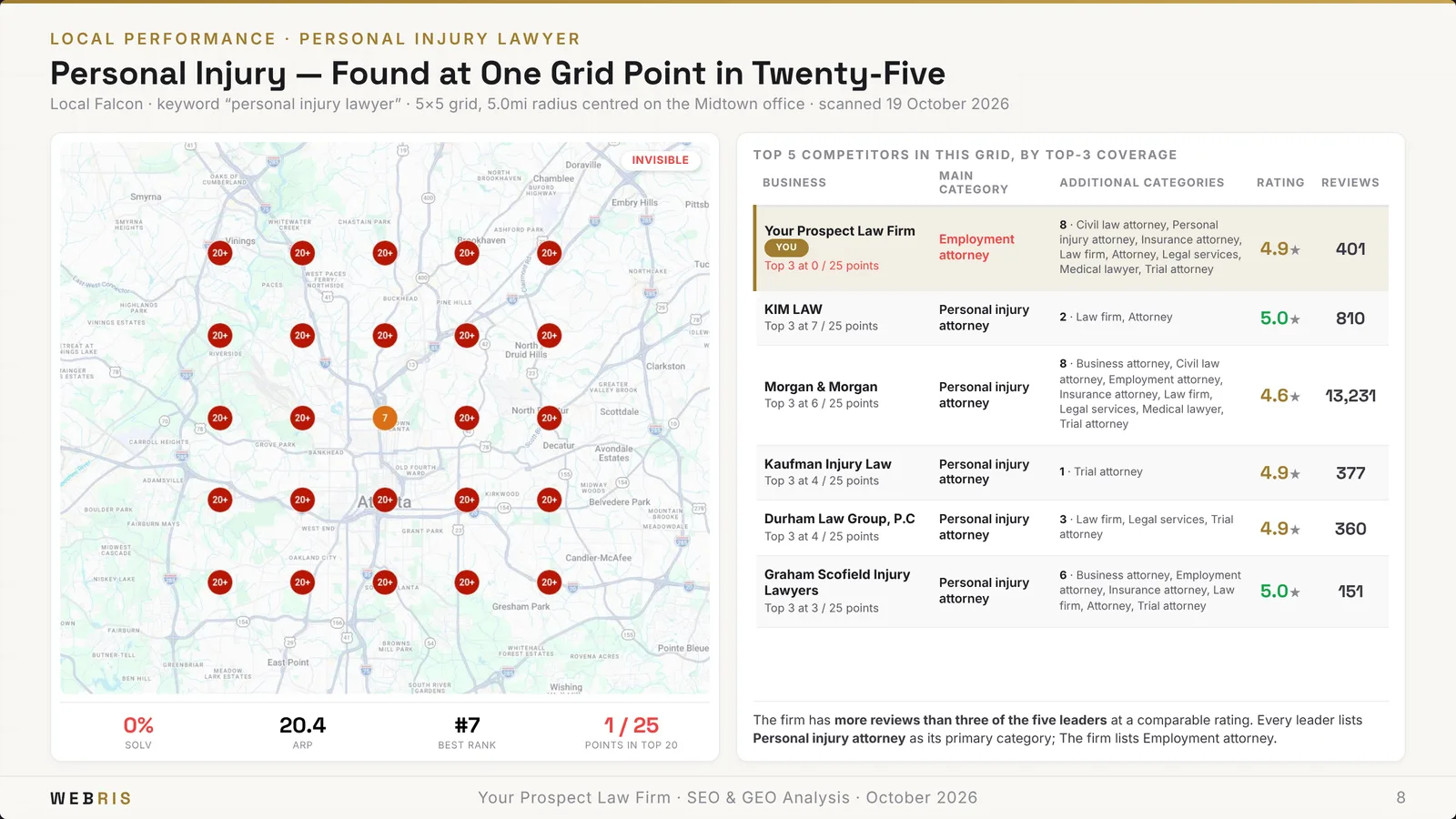
Run a map grid across their service area before the call. Most owners think they rank well because they rank from their own office. The grid shows what customers a few miles away actually see.
Our local SEO guide covers the ranking factors, and local SEO training covers how to deliver it once they sign.
Price to Their Customer Value, Not Your Hours
A pressure washing job is worth a few hundred dollars. A personal injury case is worth $15,000 or more to a law firm.
Same SEO work, very different ceiling. Ask what one new customer is worth on the discovery call, then price as a fraction of the value you can deliver.
This is why we only sell to law firms at WEBRIS. If you're still selling to everyone, read 3 agency niches that generate millions in revenue.
Start With a Small Paid Test When SEO Is Slow
Small businesses get nervous waiting months for SEO.
Local Service Ads can get the phone ringing in the first weeks while SEO builds. In many local verticals they run on a small budget, and the client pays per lead. Early calls buy you time. More on this in the paid search section below.
The 5 Rules of Agency Sales
The tools changed. These didn't.
- You're an advisor, not a closer. This isn't Wolf of Wall Street. You're a consultant and a subject matter expert.
- Protect the relationship. Some deals close on one call. Some take a year. Every week someone emails me: "Hey Ryan, we talked two years ago."
- Sell results, not services. The faster, the better.
- Don't get emotional about deals. The best deal is always the next one.
- Take away the paralysis. Prospects are overwhelmed. Is SEO dead? Should I be on ChatGPT? They freeze. Your job is to make the next step obvious.
- ✓You’re an advisor, not a closerConsultant and subject matter expert
- ✓Protect the relationshipSome deals take a year
- ✓Sell results, not servicesThe faster, the better
- ✓Don’t get emotional about dealsThe best deal is the next one
- ✓Take away the paralysisMake the next step obvious
The Old Way vs. the Two-Call Process
Here's what changed, and why it matters.
| The old way | The way we sell now | |
|---|---|---|
| Calls | Discovery, analysis, pitch | Discovery, proposal |
| Analysis | By hand, about 24 hours | Built from the call notes |
| Proposal | By hand, days | About 5 minutes |
| Lead to signed | Days to weeks | As little as one workday |
The Old Way: Three Calls and Days of Work
Before AI, our process looked like every other agency's.
Discovery call. Qualify. Build an analysis by hand, about 24 hours of work.
Analysis call. Build the proposal by hand, days of work.
Pitch call. Close.
Three calls before a signature. Every "no," at the qualifying gate or at the close, dropped into a nurture list.
The Two-Call Process We Run Now
Now it's two calls: discovery, then the proposal.
The analysis doesn't need its own call anymore. Agency OS takes the discovery call notes, pulls the data and builds the proposal in about five minutes. So the "analysis" and the "pitch" happen together, on one call, a day or two later.
Sales ends at onboarding. That's the handoff to delivery.
Step 1: Build a Single Point of Entry
Your sales process starts before the first call. It starts with where people book.
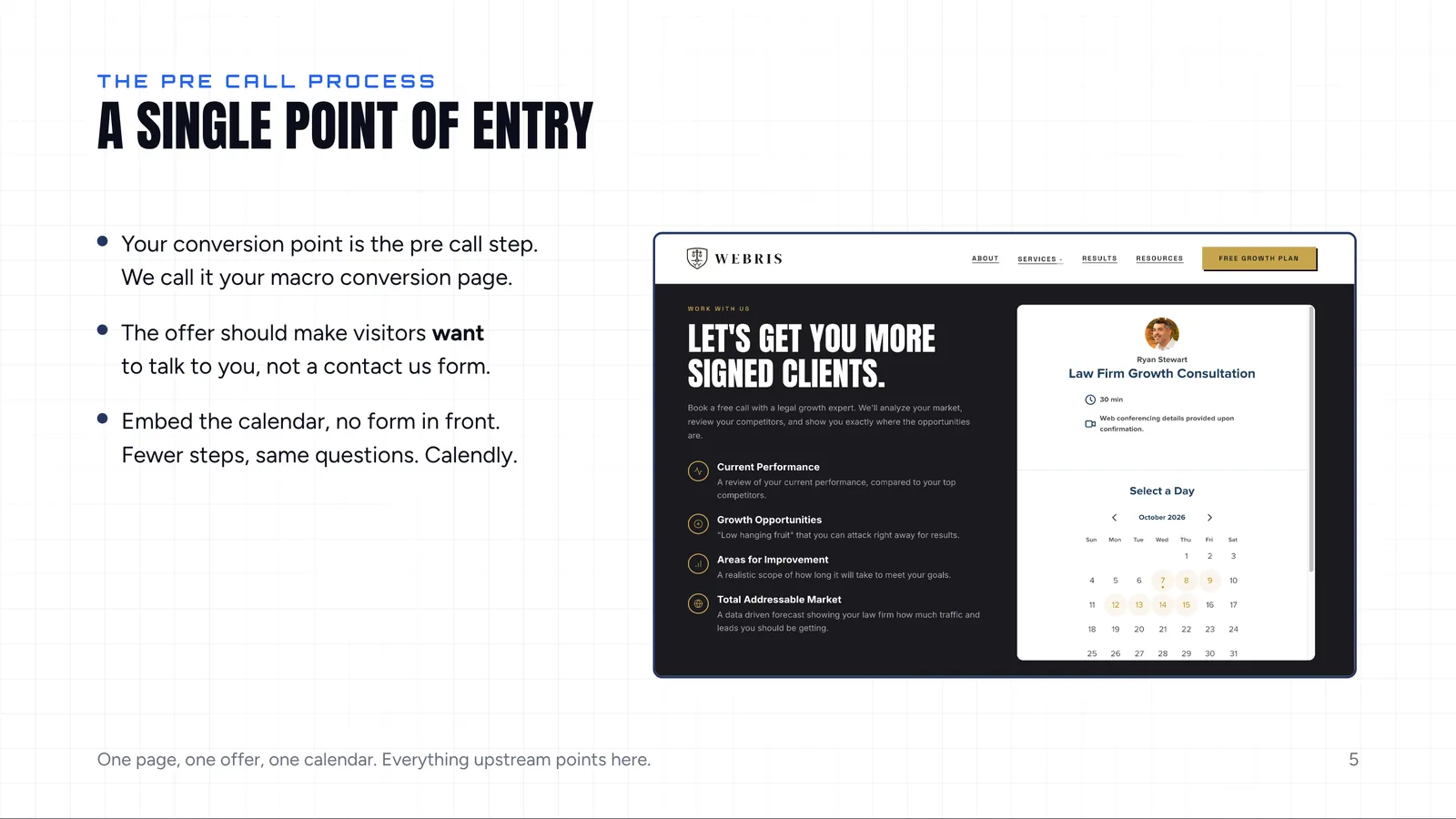
We call it your macro conversion page. Every ad, post, email and referral points to it.
- One page, one offer, one calendar.
- The offer should make visitors want to talk to you. "Contact us" is not an offer.
- Embed the calendar. No form in front of it. Fewer steps, same questions.
If you don't have this page yet, start from our 5-page agency website template.
The Offers We Actually Run
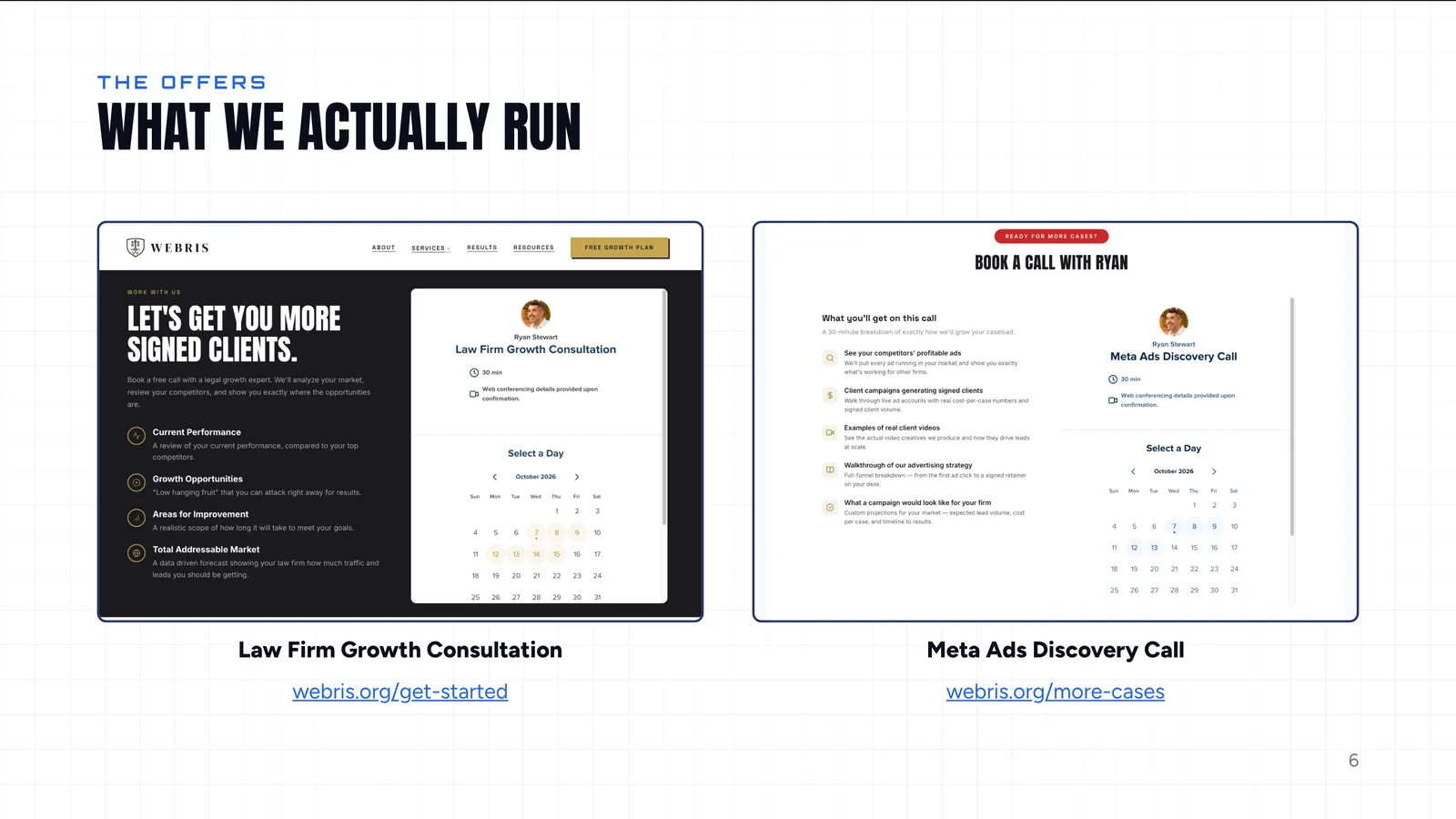
Here are the two booking pages behind most of WEBRIS's sales calls:
- Law Firm Growth Consultation for search and SEO.
- Meta Ads Discovery Call for paid social.
Each one is a single offer with a calendar on the page. Nothing else to click.
Notice both are niche-specific. "Law firm growth" converts better than "marketing consultation." If you haven't picked a niche, read 3 agency niches that generate millions in revenue.
Qualify on the Booking Form, Not on the Call
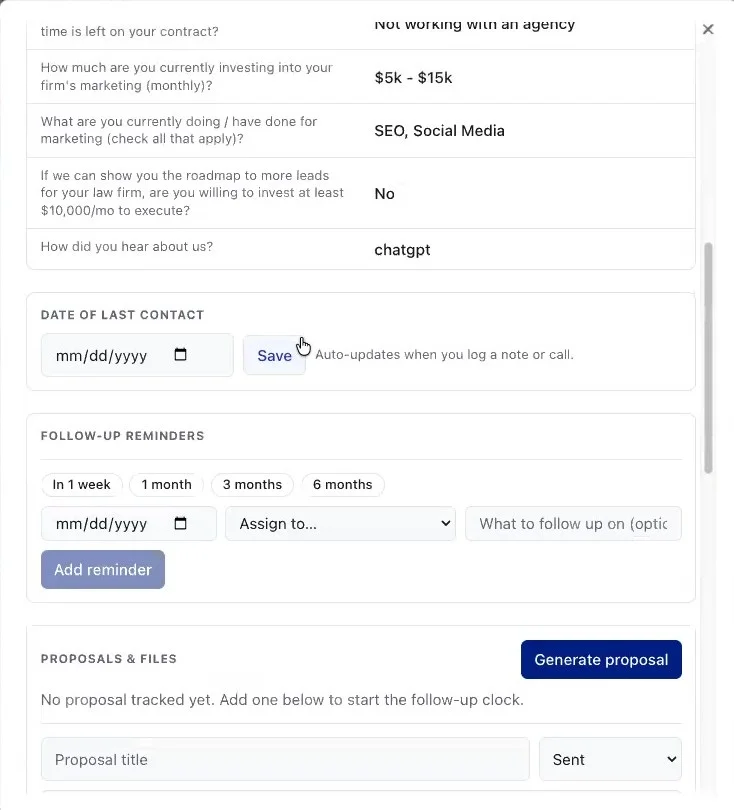
The booking form does your first round of qualifying. Put the hard questions there:
- Are you actively investing in marketing?
- If you work with an agency, how much time is left on your contract?
- How much are you investing in marketing each month?
- Would you invest at least [your minimum] to execute the plan?
- How did you hear about us?
One more setting: only allow bookings within the next 7 days. Prospects who book further out tend not to show.
In Agency OS, every booking lands in the pipeline with these answers on the lead and a qualified or not-qualified flag. Not qualified doesn't mean cancel. It means check their website and decide.
Step 2: Run the Discovery Call
A discovery call isn't a sales call.
You're finding out two things: what they need, and whether you even want to build them a proposal. It goes both ways.
Prep: 15 Minutes, Four Checks
My college football coaches had a line for this: "Have an idea, son." Know what you're doing before you step on the field.
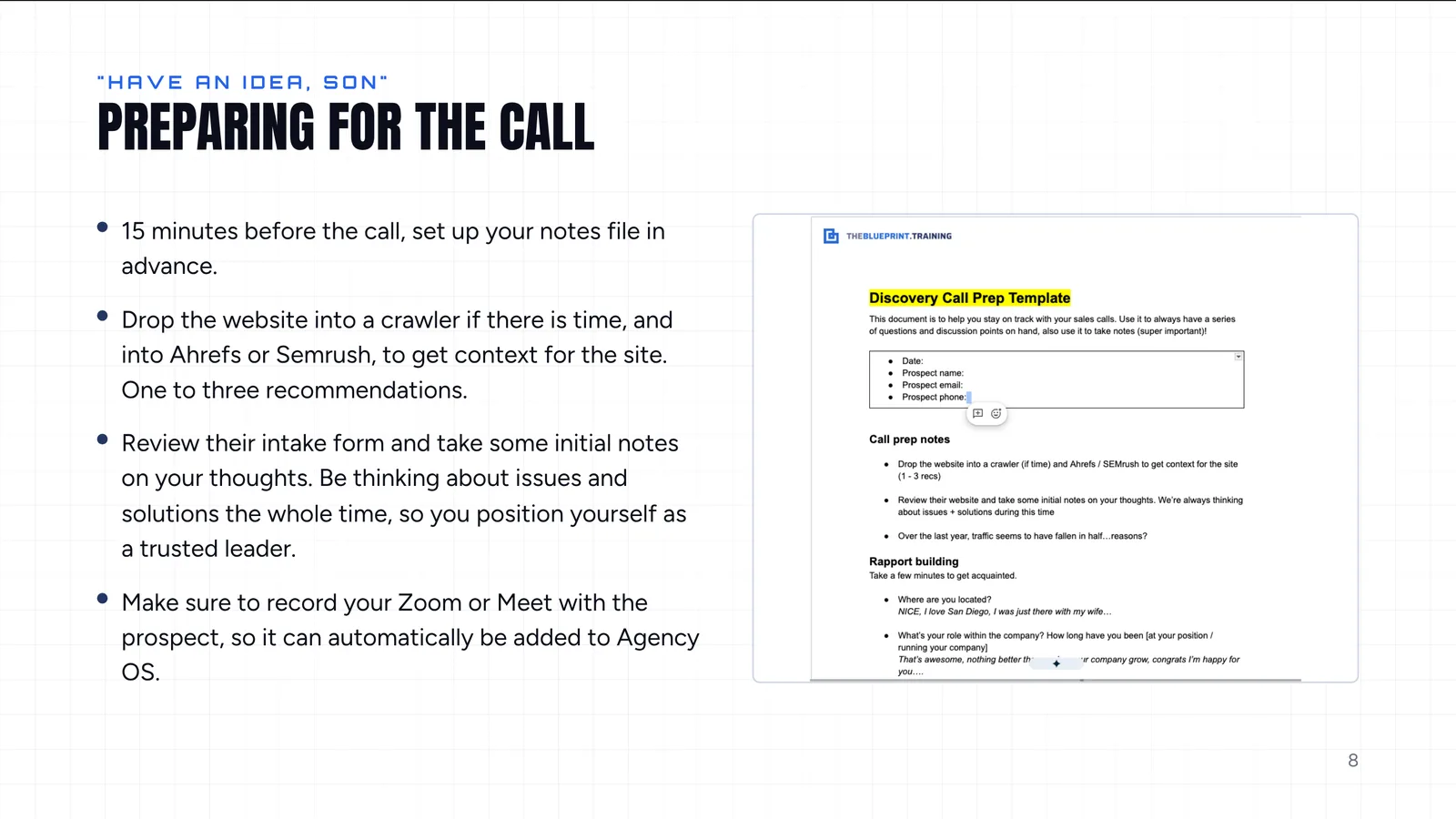
Fifteen minutes before the call:
- Size them up. Team size, locations. Seven attorneys and three offices tells you more about budget than their form answers.
- Run a quick Ahrefs or Semrush check. High level only. How is the site performing?
- Read their booking-form answers. Start forming one to three recommendations.
- Set up the recording. Every call goes into the CRM for context.
The Six-Step Call Flow
- Rapport. A few minutes. No more.
- Their story. One open question: "Tell me about the business and what you've done for marketing to date." Then be quiet. The more they talk, the better it goes.
- Dig in. What worked? What didn't? How did you measure it? Every answer is a clue for the proposal.
- Your story. Two minutes of experience and confidence. Then say it out loud: "Based on everything you told me, we're a perfect fit to work together."
- Price range. Give a range and ask if they're comfortable with it.
- Book the next call while they're still on this one. Once they hang up, you're chasing.
| Step | What you say or do |
|---|---|
| 1. Rapport | A few minutes. No more. |
| 2. Their story | "Tell me about the business and what you’ve done for marketing to date." |
| 3. Dig in | What worked? What didn’t? How did you measure it? |
| 4. Your story | "Based on everything you told me, we’re a perfect fit to work together." |
| 5. Price range | Give a range. Ask if they’re comfortable with it. |
| 6. Next call | Book it before they hang up. |
The Questions That Size the Deal
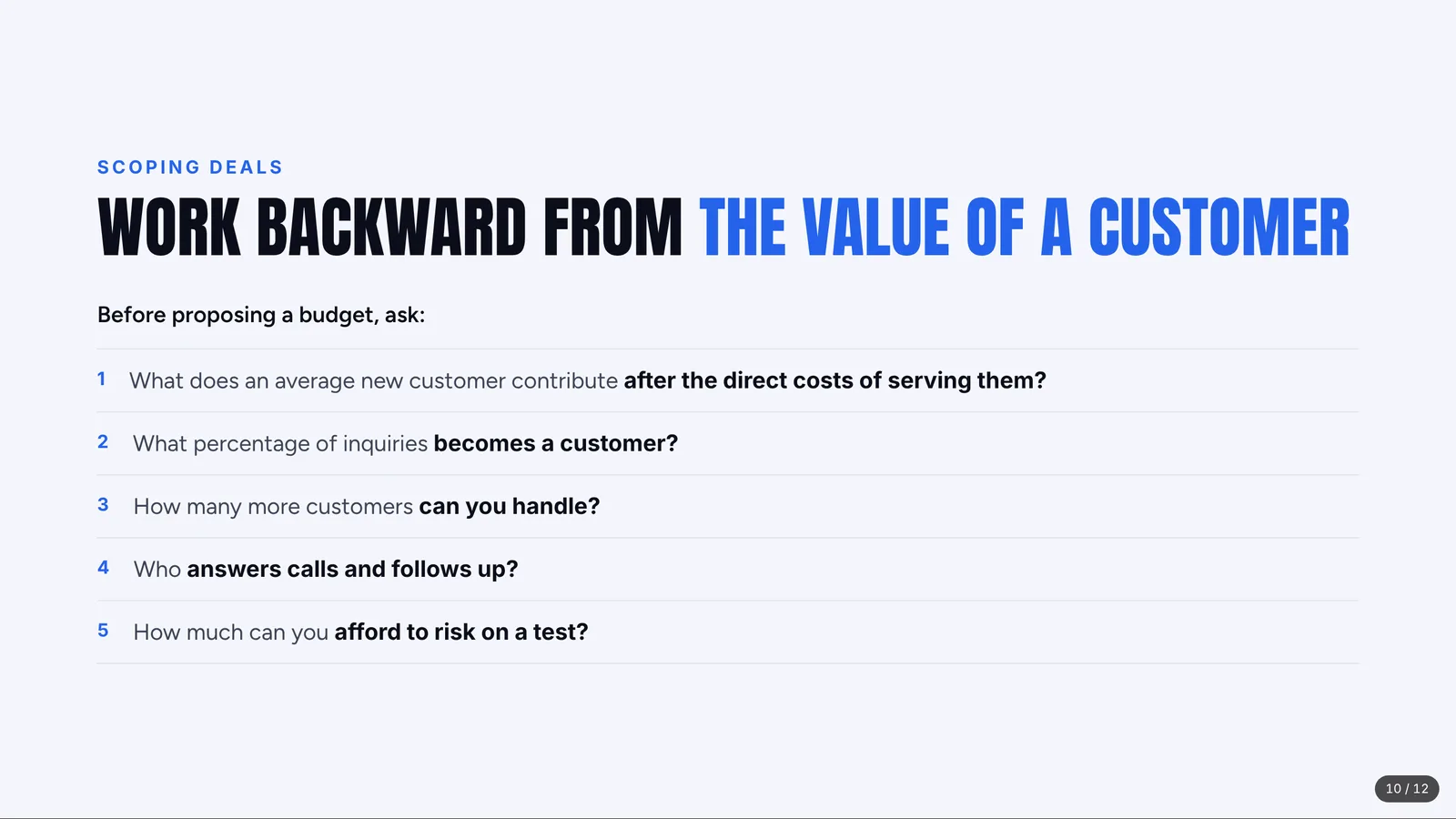
Before you can propose a budget, you need five answers. These come straight from how we scope every deal:
- What does a new customer contribute after the direct costs of serving them?
- What percentage of inquiries become a customer?
- How many more customers can you handle?
- Who answers the calls and follows up?
- How much can you afford to risk on a test?
Questions 1 and 2 set your price ceiling. Questions 3 and 4 tell you whether more leads will even turn into more revenue.
The full list is in our client questionnaire template.
Talk Price on the First Call
I know what you're thinking: "Isn't it too early to talk money?"
No. Give a range before you build anything.
If they're comfortable, you build the proposal knowing the number will land. If they're not, you just saved both of you a week.
How we land on the range is in 7 SEO pricing models for agencies.
Price at the end
- ✕Build for days
- ✕Surprise them on the call
- ✕"Let me think about it"
Range up front
- ✓Range on call one
- ✓Build knowing it lands
- ✓Or save a week
How to Pitch Paid Search on the Discovery Call
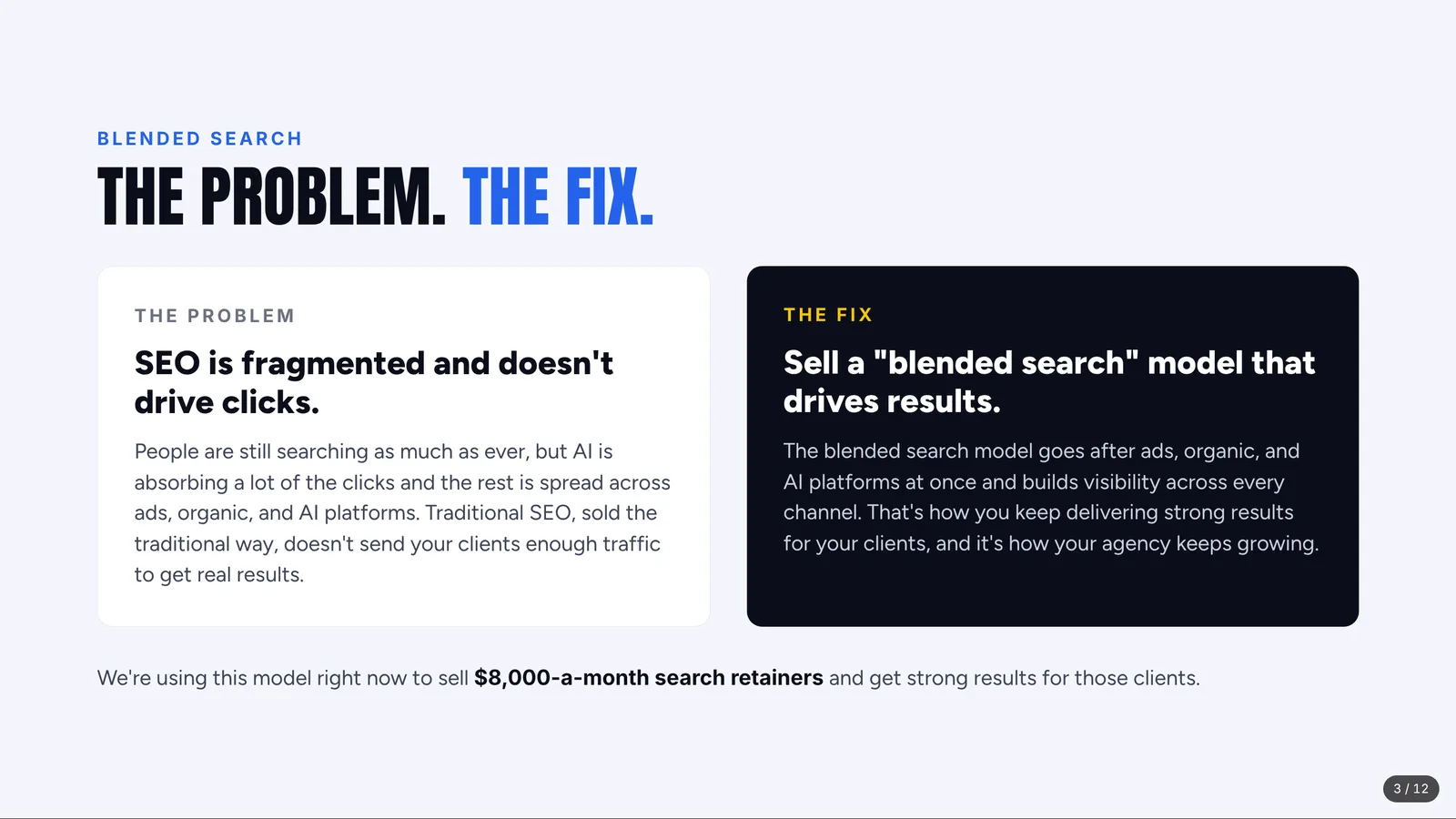
Here's the uncomfortable truth. Prospects are telling us "I'm done with SEO."
And it's not always the last agency's fault. The clicks moved.
According to the Pew Research Center, Google users clicked a traditional search result on 8% of visits when an AI summary appeared, versus 15% when one didn't (March 2025 browsing data).
So on the discovery call, I stop selling "SEO" and start selling the whole search page.
Search Is Fragmented. Show Them.
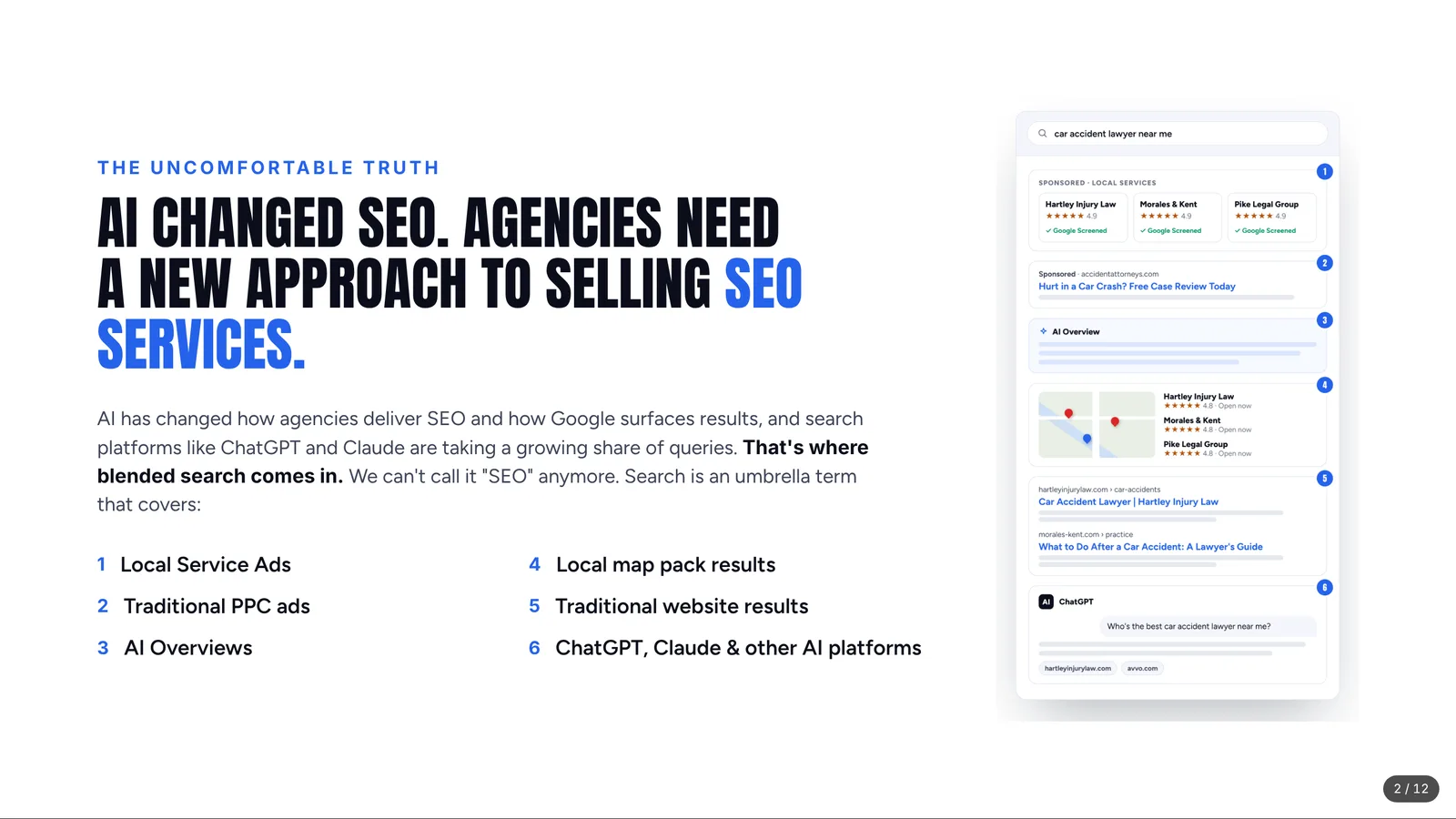
Pull up their main keyword, live, while you're on the call. Walk them through everything above the organic listings.
A single search now returns six things: Local Service Ads, PPC ads, AI Overviews, the Maps pack, website results, and ChatGPT and other AI platforms.
Then give them the roulette pitch: selling SEO alone is like putting all your chips on red. We spread the chips across the table.
Sell the Outcome, Not the Channel
Don't sell ad spend. Don't sell "PPC management."
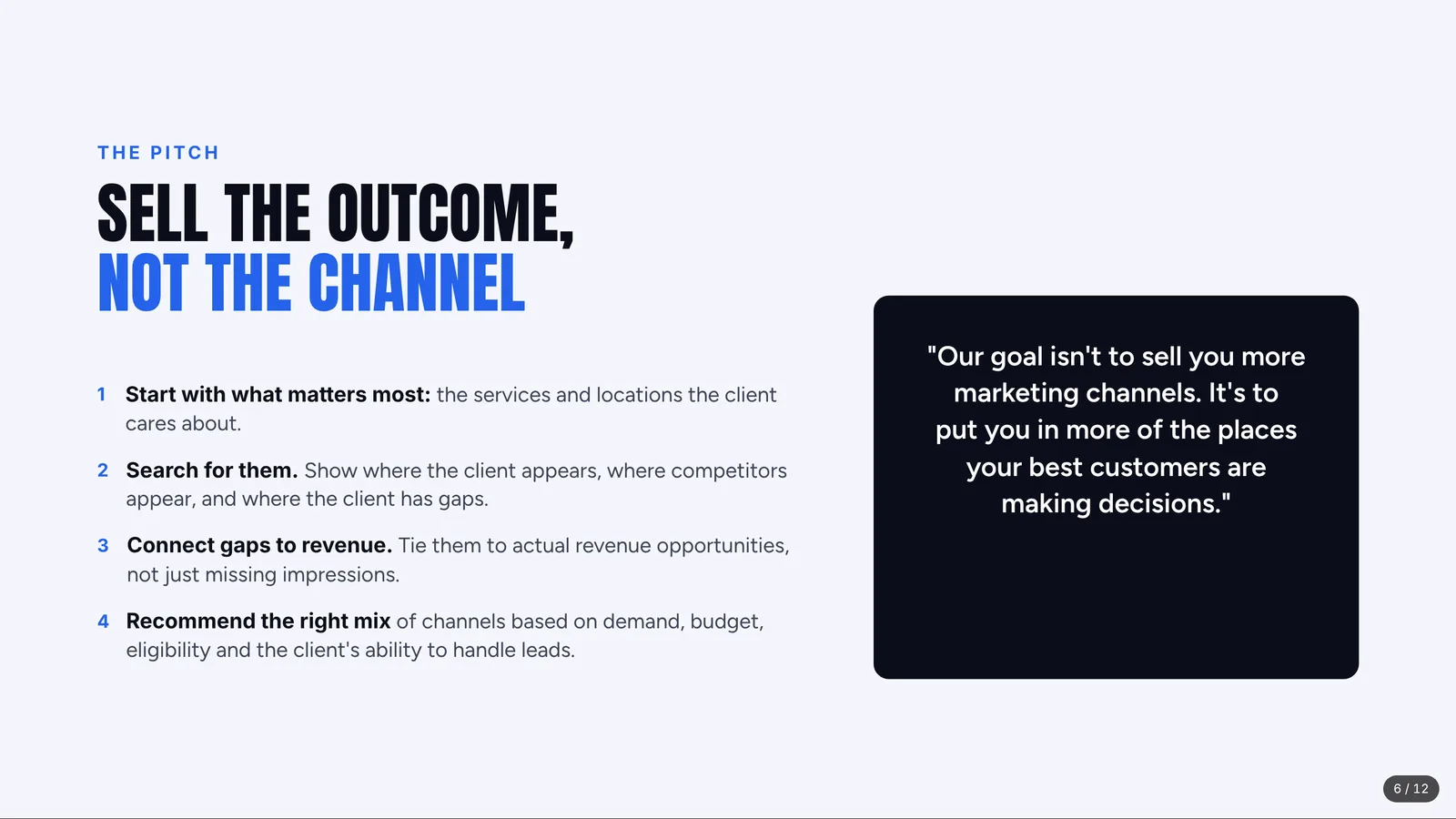
Start with the services and locations they care about. Search for them.
Connect the gaps to revenue. Then recommend the mix of channels that fits their demand, budget and ability to handle leads.
The line we use:
"Our goal isn't to sell you more marketing channels. It's to put you in more of the places your best customers are making decisions."
How to Pitch PPC to an SEO Client
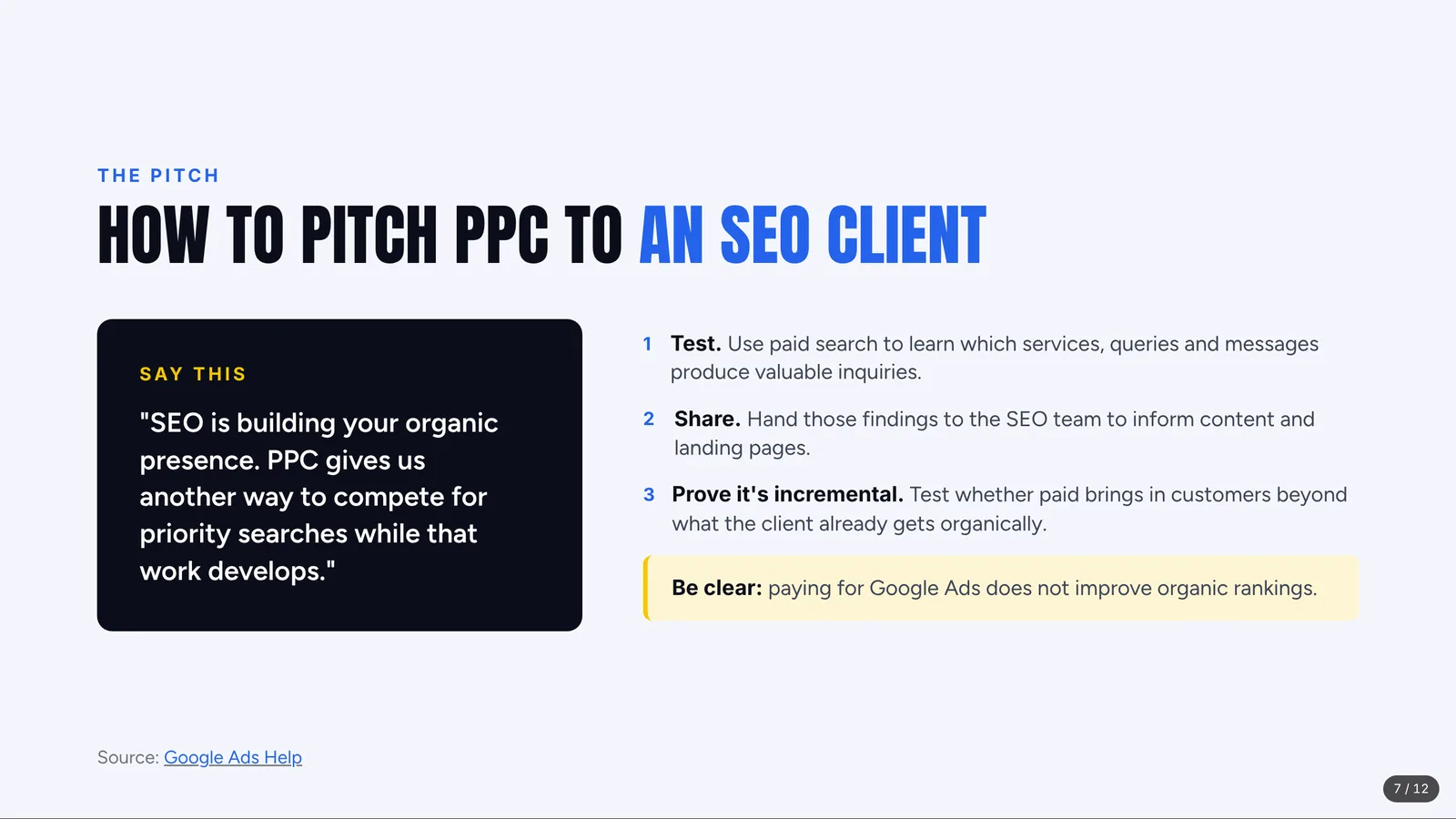
Position PPC as a complement to SEO, not a replacement. It gets leads in the first week while SEO builds.
Say this: "SEO is building your organic presence. PPC gives us another way to compete for priority searches while that work develops."
And be straight with them. Google says its search results are independent of its advertising programs. Ads don't improve organic rankings.
The forecast and the budget math are in how to build a PPC proposal.
How to Pitch Local Service Ads
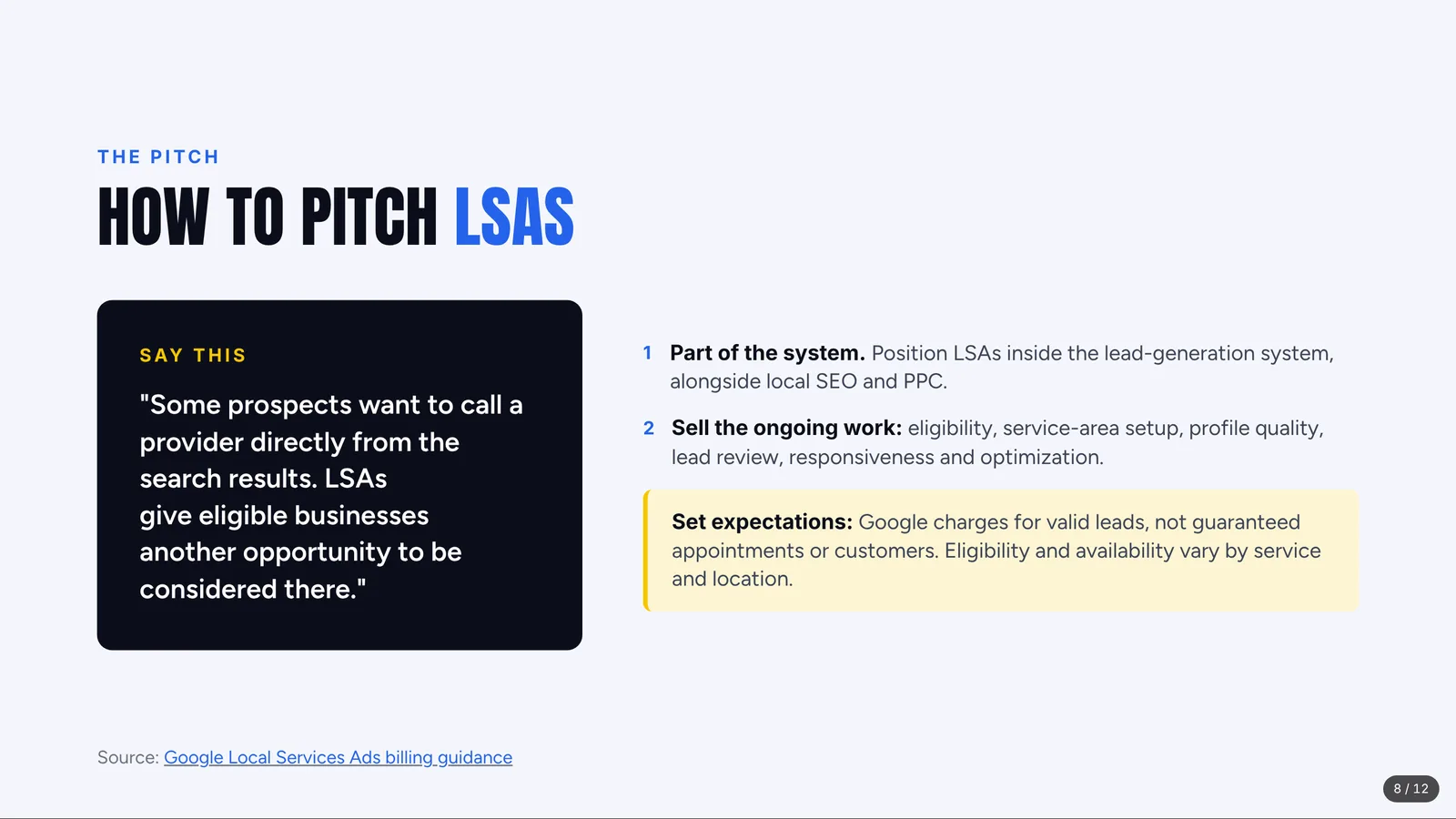
Put Local Service Ads in every local proposal. They sit at the very top of Google, and the client pays per lead, not per click.
Set expectations up front. Google says you're charged for each valid lead, and leads judged invalid or low quality aren't charged. That means a valid lead, not a booked appointment or a signed customer.
Run the Downside Case
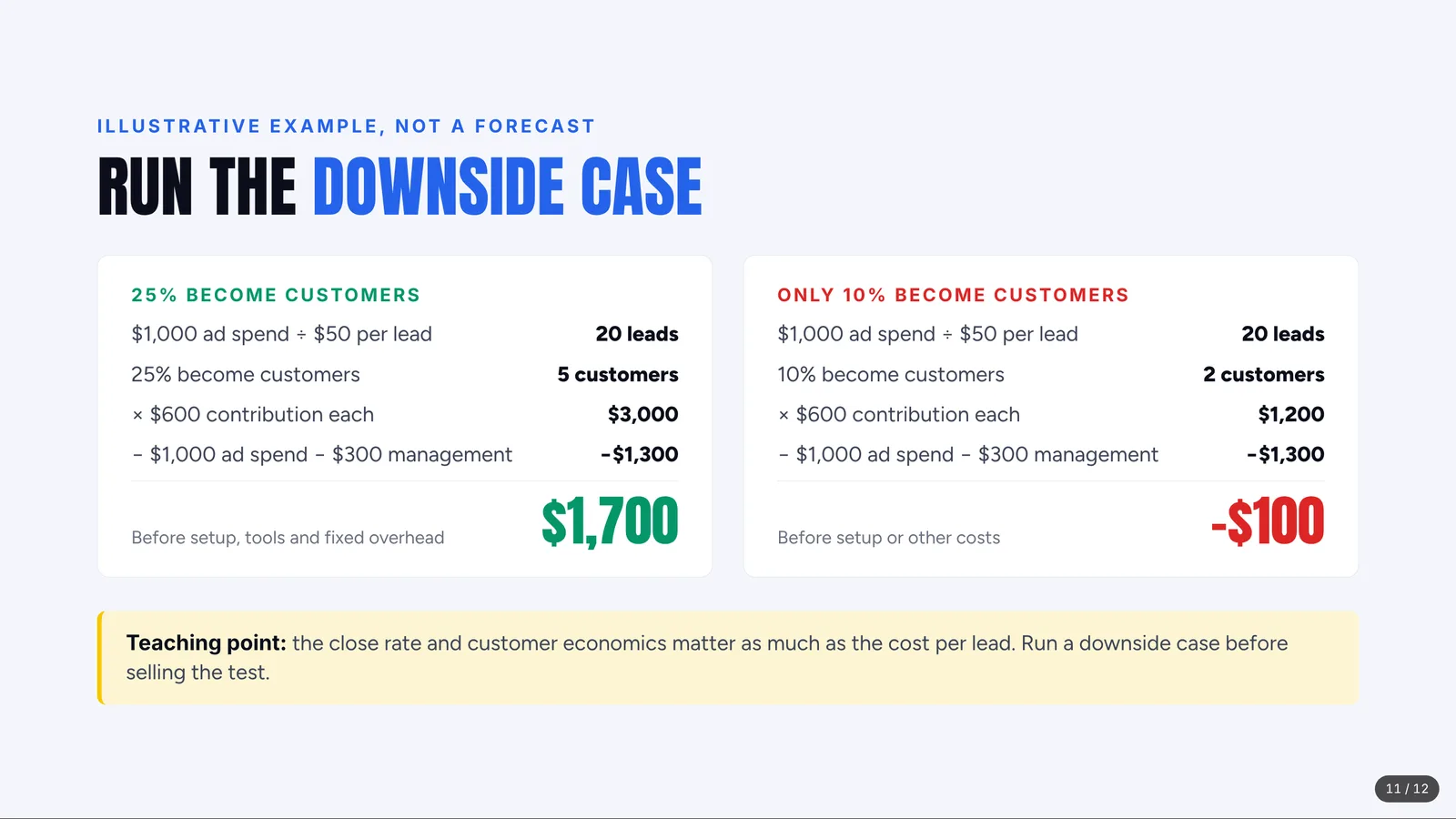
Before you sell a paid test, show what happens if it goes badly.
Same $1,000 in ad spend, $50 per lead, 20 leads, $600 contribution per customer:
- 25% become customers: 5 customers, +$1,700 after spend and a $300 fee.
- 10% become customers: 2 customers, -$100.
The close rate matters as much as the cost per lead. That's why the next question matters so much.
Ask Who Answers the Phone
Most agencies skip this question: "Who answers the calls?"
If the owner takes every lead himself, he'll burn out on the bad ones and blame you. Fix that before you take the account, or you'll lose it in month three.
Owner takes every call
- ✕Burns out on bad leads
- ✕Misses calls
- ✕Blames the agency
Someone owns intake
- ✓Every call answered
- ✓Leads followed up
- ✓Results you can measure
Step 3: The Proposal Call
By the time you're on the second call, the proposal is built. In Agency OS, it took about five minutes from the call notes.
The proposal call is simple. Walk them through it, slide by slide. It covers five things:
- ✓Understanding of their problemThe analysis does the work
- ✓Your expertiseIn their own language
- ✓A clear planThe scope is the plan
- ✓Clear pricingNothing to decode
- ✓Expectation of resultsForecast, case studies, experience
- Understanding of their problem. This is where the analysis does the work.
- Your expertise. Talking through their problems in their own language.
- A clear plan to solve them.
- Clear pricing. Nothing to decode. Price confusion is how deals stall.
- Expectation of results. From the forecast, case studies and your experience.
How we build the deck itself, with a real $4,000/month example, is in how to write an SEO proposal.
Close With Two Questions
When you've walked the plan and given the price, ask:
- "Is there anyone not on this call who'll be involved in the decision?"
- "When can I expect a decision from you on this?"
Then stop talking.
That date becomes your follow-up.
"Is there anyone not on this call who’ll be involved in the decision?"
"When can I expect a decision from you on this?"
Step 4: Follow Up and Close
Most deals aren't lost on the proposal call. They're lost in the silence after it.
Speed matters here. A Harvard Business Review study of 2,241 U.S. companies (March 2011) found firms that contacted a lead within an hour were nearly seven times as likely to qualify it as firms that waited longer.
The same logic holds after the proposal. The agency that follows up first controls the conversation.
The Follow-Up Sequence
- Decision date. The one they gave you on the call.
- Check in on that date.
- About four nudges, a few days apart.
- A call or a text.
- A final "close the loop" email.
Personal, not automated. This is high ticket. A sequence that reads like a robot kills the relationship you just built.
Always Be Kind
No matter how frustrating the prospect is.
Deals come back. On timing, on pricing, or because they hired a bad agency and want out. If they said "not yet," move them to nurturing and set a reminder for when they asked you to come back.
Every open deal should have a next date.
- ?TimingThey weren’t ready. Now they are.
- ?PricingBudget opened up next quarter.
- ?A bad agencyThey hired someone else and want out.
How We Run the Sales Process in Agency OS
Everything above runs through Agency OS, the software included with The Blueprint Training. One operator, one pipeline, and the work between the calls handled for you.
Bookings Land in the Pipeline on Their Own
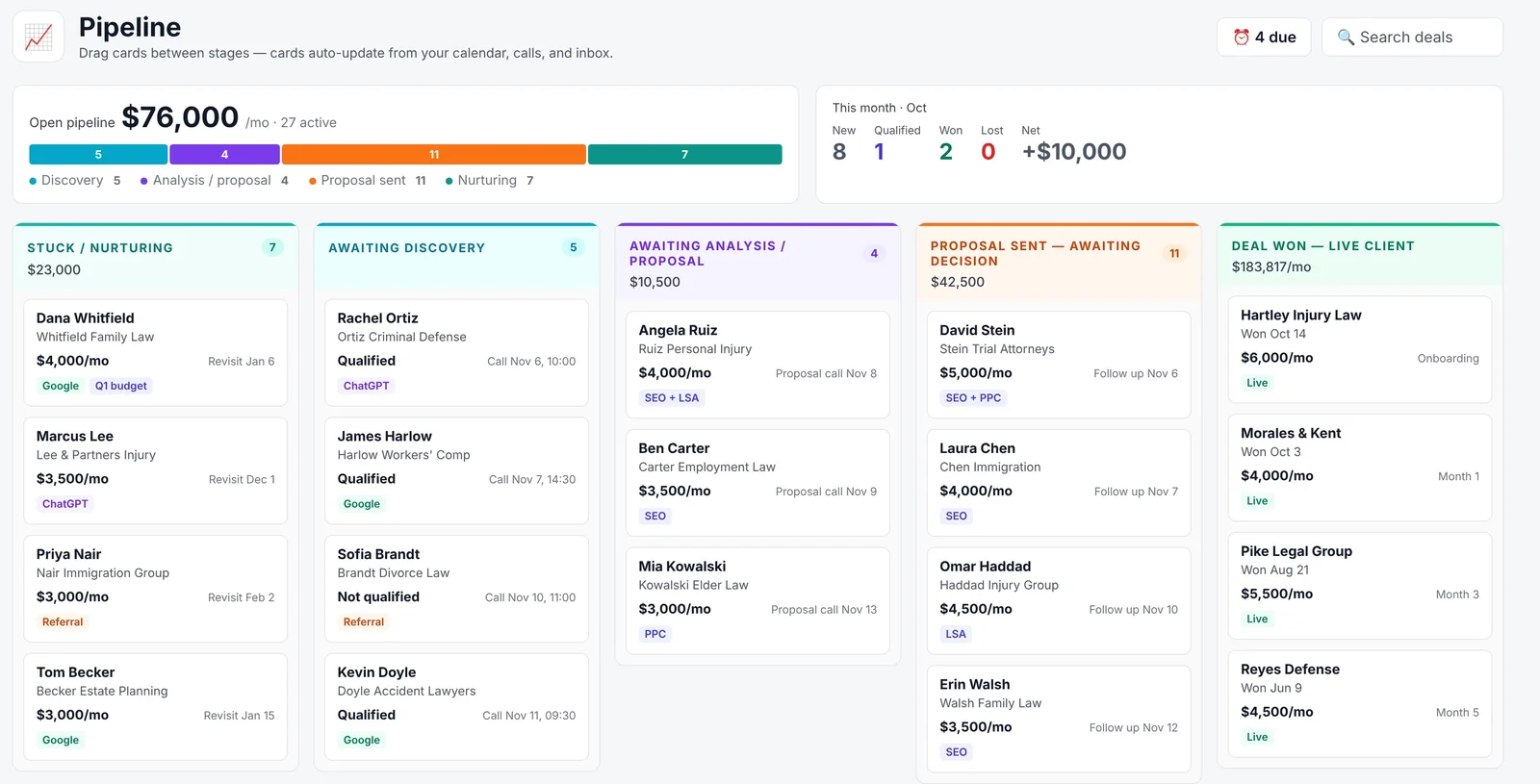
Connect your booking calendar once. Every booked call lands in the Agency OS CRM in Awaiting Discovery, with the booking-form answers and a qualified flag.
Deals move through the stages as you work them: awaiting discovery, awaiting proposal, proposal sent, won or nurturing. The pipeline basics guide covers each stage.
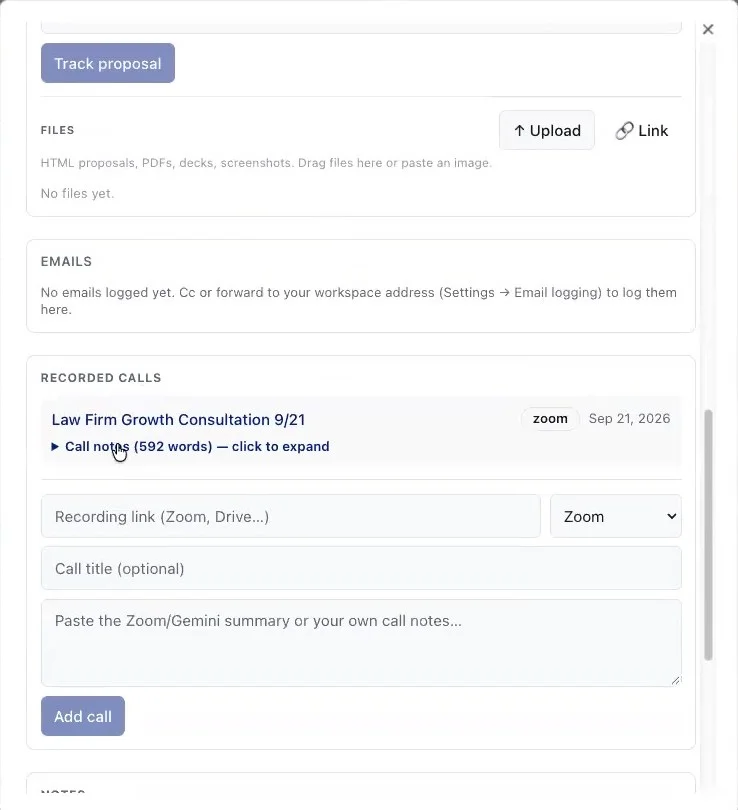
Every Call Is on the Lead's Card
Record your discovery call in Zoom or Google Meet. The recording and the notes attach to the lead automatically, through Claude connected to Agency OS.
You never lose what the prospect said they wanted. And those notes become the proposal.
One Click Builds the Proposal
On the lead, click Generate proposal. The call notes go into the Proposal Builder with the lead already selected.
About five minutes later, you have a 20-slide deck built from their real data. Send it, and the deal moves to Proposal Sent with the link logged.
Follow-Ups Never Slip
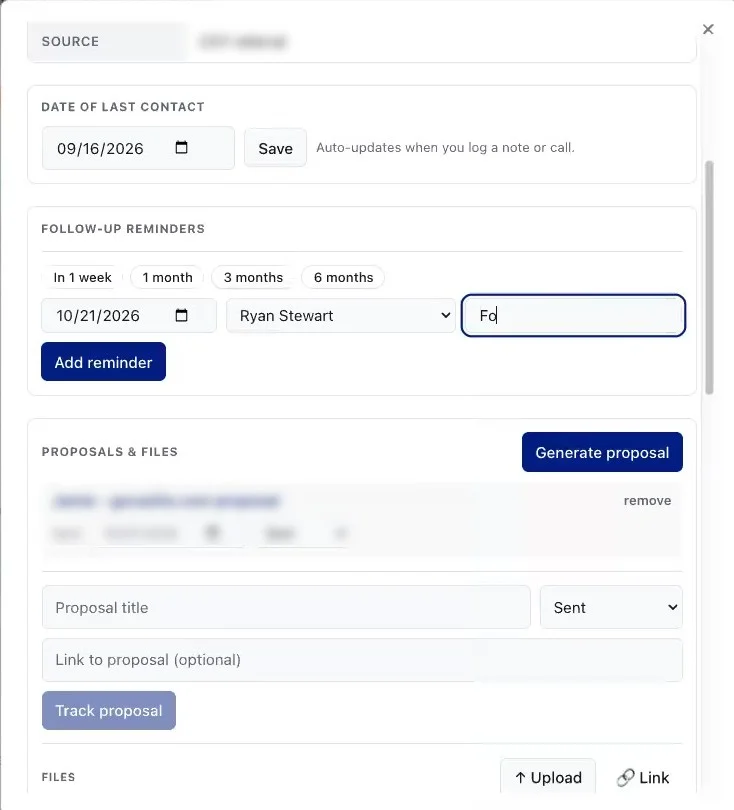
The decision date becomes a follow-up reminder, assigned to you or a teammate. It shows up on your Today view the morning it's due.
And you can see how deals move through the whole funnel in pipeline metrics and deal velocity.
- ✓Pick a dateIn 1 week, 1 month, 3 or 6 months, or a date
- ✓Assign itTo you or a teammate
- ✓Add the contextWhat to follow up on
- ✓See it on TodayThe morning it’s due
Agency Sales Mistakes That Cost You Deals
- ❌ A "contact us" form instead of a calendar. Every extra step loses bookings.
- ❌ Taking every call. Qualify on the form first.
- ❌ Pitching on the discovery call. Listen first. The more they talk, the better it goes.
- ❌ Hiding the price until the proposal. Give a range on the first call.
- ❌ Selling channels instead of outcomes. Nobody wants "PPC." They want customers.
- ❌ Ending the call without a next step. Book it or get a decision date.
- ❌ Automated follow-up on a high-ticket deal. Make it personal.
- ❌ Burning the bridge on a "no." Deals come back.
- ✕A contact form instead of a calendar
- ✕Taking every call
- ✕Pitching on the discovery call
- ✕Hiding the price
- ✕Selling channels, not outcomes
- ✕No next step on the call
- ✕Automated follow-up
- ✕Burning the bridge on a no
Selling SEO FAQs
How do you sell SEO services to local businesses? Talk in phone calls and booked jobs, not rankings. Lead with a map pack grid across their service area, price to what one new customer is worth to them, and use Local Service Ads for early calls while SEO builds.
How do you sell SEO without being pushy? Act like an advisor, not a closer. Ask, listen, show them their own data, and give one clear recommendation. If they're not a fit, say so.
How many sales calls does it take to sell SEO? Usually two: a discovery call and a proposal call. A third happens when another decision-maker needs to join.
What should you ask on a discovery call? Open with "Tell me about the business and what you've done for marketing to date." Then dig into what worked, what didn't and how they measured it. To size the deal, ask what a new customer is worth, their close rate, their capacity, who answers the calls and how much they can risk on a test.
Should you discuss price on a discovery call? Yes. Give a range before you build the proposal. If they're not comfortable with it, you've saved both sides the time.
How fast should you send a proposal? Fast enough to present it on the second call, ideally within a day or two. In Agency OS, building it takes about five minutes.
Should agencies automate sales follow-up? Automate the reminder, not the message. Agency deals are high ticket, so the follow-up should come from you.
What CRM should an agency use for sales? One built around the agency sales stages: discovery, proposal, follow-up and won. Agency OS includes a CRM that also holds the call recordings and builds the proposal from them.
Learn to Sell SEO From Someone Who Does It Every Week
The Blueprint Training gives you the complete agency sales module, recordings of real sales calls, the discovery call prep template, and Agency OS with the CRM and Proposal Builder built in.
Join The Blueprint Training →